FILE Nº 0060 · History · DECLASSIFIED
The Persian King Who Tore Up the Prophet Muhammad's Letter: Events Before Persia Was Conquered by Muslims
TL;DR — Before Iran embraced Islam, Iranians followed Zoroastrianism, or fire worship.
Before Iran embraced Islam, Iranians followed Zoroastrianism, or fire worship. This religion was long patronized by the Persian court and became the state religion of three great Persian empires: the Achaemenid, Parthian and Sasanian empires.
In the Sasanian era, the last of the ancient Persian empires, Zoroastrianism flourished greatly, leaving the Zoroastrian priesthood with secure power and great wealth from money collected from the faithful as fees for religious rites and payments for atonement of sins.
But from 602 to 628, the Sasanian Empire under King Khosrow II fought a fierce war with the Byzantine Empire and exhausted much of its resources.
Meanwhile, in the Middle East, the Prophet Muhammad began spreading Islam in 613 but met opposition, so he migrated from Mecca to Medina in 622. While spreading Islam and uniting the various tribes, the Prophet Muhammad sent letters to the leaders and kings of various realms inviting them to embrace Islam, including Emperor Khosrow II.
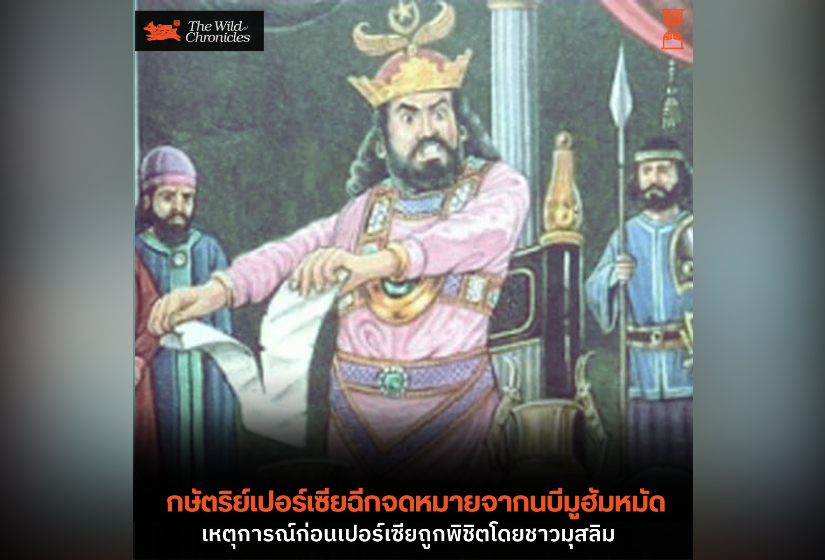
The contents of the letter enraged Khosrow II so much that he tore it up without a second thought. He even ordered the governor of Yemen to arrest the Prophet. But when the soldiers met him, the Prophet Muhammad told them that Khosrow II's empire would be torn to pieces and collapse! The soldiers were stunned by this statement and did nothing to him.
The Prophet's words came true when the Persian army was defeated by Emperor Heraclius of the Eastern Roman Empire. Heraclius offered Khosrow II the chance to surrender, but out of pride and soldierly honor he refused to bow to anyone, and in 628 King Khosrow II was executed.
Persia then fell into civil war after the death of King Khosrow II. This greatly weakened the Sasanian Empire and was another factor in its collapse, until it was conquered by the Islamic state in 651.
However, studies have found that the Prophet Muhammad could not read or write, so the letters were probably written by his assistants. Although the originals of these letters may not survive to the present day, the story of the letters was recorded in the Quran.
And although the Persians' conversion to Islam caused the ancient Zoroastrian religion to decline in popularity, until it survived only in remote communities, the Persians held firmly to their own language and culture.
Persian cultural influence on Islamic culture was also so great that the two are almost inseparable, as can be seen in many Islamic arts and architecture that carry traces of Persian civilization. The later expansion of the Islamic empire also spread Persian-ness to various regions of the Islamic world...
#TWCHistory #TWCIran #TWC_Rama