FILE Nº 0582 · History · DECLASSIFIED
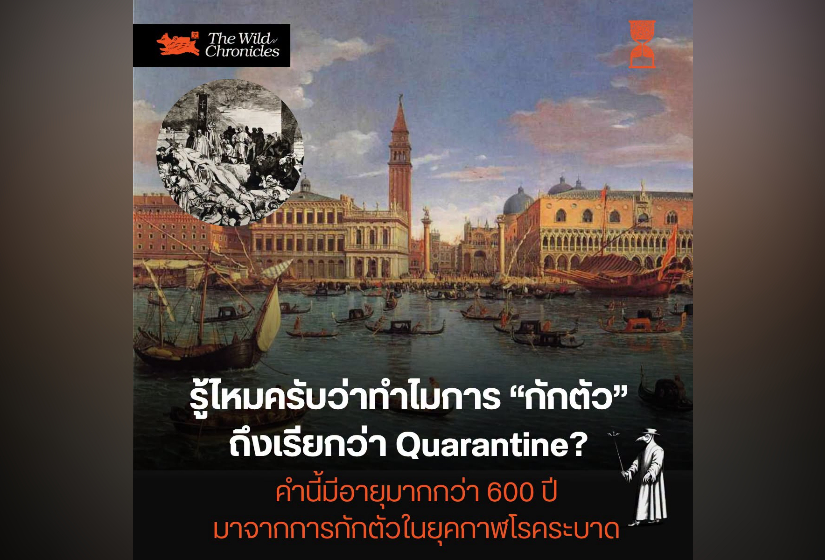
Why Is Staying Isolated Called “Quarantine”? The Word Is Over 600 Years Old, Born in the Age of the Black Death
TL;DR — I recently watched Resident Evil, and with news of an outbreak from Russia, I went looking for interesting content and found the origin of “Quarantine”.
The other day I got to watch Resident Evil, and with news of an outbreak from Russia lately, I went looking for interesting content and came across the origin of the word “Quarantine”.
Did you know that the word “Quarantine” we are so used to has an origin..
It is actually a word more than 600 years old, with origins going back to the time when the Black Death was killing people across Europe.
Go back to the mid-14th century, the Middle Ages, when Europe faced a huge outbreak of the Black Death, which killed an enormous part of Europe's population.
At that time humans did not yet know about bacteria and did not understand how the plague spread.
Many people believed the disease came from “bad air”, and some saw it as punishment from God.
Even without knowing the cause, people in port cities began to notice one thing..
When ships from areas with an outbreak arrived, the disease often appeared in the city soon afterwards.
They could guess that the trading ships were the source.
But the big problem for the trading ports around the Mediterranean and the Adriatic was that they could not close all their ports, because trade was the main artery feeding the city economies of that era (like some countries around here that cite tourism, right?).
In 1377, the Republic of Ragusa, or the city of Dubrovnik, introduced a measure: people arriving from areas with the plague were not allowed into the city immediately but had to be separated and kept in an area outside the city for 30 days, to see whether any illness appeared.
This measure was called “Trentino”, from the Italian word trenta, meaning “thirty”.
If after 30 days they showed no symptoms, they were then allowed to enter the city.
This is considered one of the oldest formal quarantine systems in Europe.
( The idea of isolation to prevent epidemics goes back to ancient times, with evidence in the Old Testament of the Bible, which requires people with leprosy or certain skin diseases to separate from the community so the disease does not spread to others. But quarantine developed into a systematic state measure in Europe around this period. )
The idea was later adopted in other port cities, and the isolation period was gradually extended from 30 days to 40 days.
The term for this 40-day period came from the word quaranta, meaning “forty”, and developed into quarantino or quarantena.
Later it became the English word “Quarantine” that we use to this day.
As for why it had to be “40 days”, there is actually no definitive answer.
One theory relates to Christianity, since the number 40 appears often in the Bible, from the rain that fell for 40 days and 40 nights in the story of Noah's Ark to Jesus fasting in the desert for 40 days.
The number 40 therefore carries a religious meaning of a time of testing, purification and transition.
Another idea may relate to the medical beliefs of the time, which held that if certain serious diseases did not show symptoms within a certain period, the traveller was probably safe enough to enter the city.
But whatever the reason, this measure really did reduce the risk of bringing disease into the city, even though people at the time did not yet understand what germs were.
One of the cities that developed this system most seriously was Venice, because in that era Venice was a maritime trading power, with ships and people from many lands constantly coming and going.
In 1423 the Republic of Venice established a place to separate the sick and those who might bring in disease, on the island of Santa Maria di Nazareth in the Venetian Lagoon, later known as “Lazzaretto Vecchio”.
This kind of place was called a “Lazaretto” and became the model for quarantine stations in port cities across Europe.
Travellers might be held on the island, while their belongings and goods were kept apart from the city. Some were aired out or fumigated, following the beliefs of the time about removing whatever caused disease.
So a simple idea born amid death from the Black Death more than 600 years ago became one of the key foundations of the modern public health system, and left its mark in a word we still use every day.
References: pmc(ดอท)ncbi(ดอท)nlm(ดอท)nih(ดอท)gov/articles/PMC7133622/
#TWCHistory #TWCItaly #TWCCroatia TWC_Salmon