FILE Nº 0648 · Travel · DECLASSIFIED
A Review of Iran with The Wild Chronicles, by Tarasin
TL;DR — If someone asks when is the best time to go to Iran, someone who has been just once would say: right now. Spring, April to May.
*** A review from Tarasin ***
If someone asks when is the best time to go to Iran, someone who has only been once in this lifetime would say: right now. Spring, April to May, is probably the best time. The weather is lovely at 13–25 degrees, flowers bloom all over the cities, and the sun is bright, so photos come out beautifully, but it isn't hot.
There must already be plenty of Iran reviews on the forum, but let me add one more thread, sharing small, memorable details about this ancient land of Persia.
I went to Iran with The Wild Chronicles, run by Khun Pup, the owner of the famous login who tells the history of Eastern Europe, the Middle East and Muslim countries, and whose posts have topped Pantip for two or three years running.
I was not disappointed. On top of visiting mosques, palaces and beautiful places, there were so many fun and interesting stories told from many angles: fun, heartbreaking, jaw-dropping, admirable, and full of the aesthetic beauty of this Persian land.
Normally when I tell a story I go in chronological order, but this time I'll write it as numbered notes picked up from the trip: what I found interesting, fun, strange, or something we might not have thought of.
1. Khun Pup said this trip is IRAN 101, because honestly this country can be organised into many routes, just like China. It is so large and varied that you can design a trip around a theme, depending on what you want to focus on each time.
This time we took in the big picture, from the ancient Persian empire up to the turning point of contemporary history, the revolution and the overthrow of the regime more than 40 years ago, whose effects reach to the present. We visited three main cities: Tehran, the present capital; Shiraz, an important city in the south; and Isfahan, a former capital famed for its beauty.
2. Before going to Iran, I checked my passport and saw it had only 1 year left and needed renewing. So I decided to go, since I would renew it next year anyway and wouldn't regret using up the old one. I had heard that if your passport carries an entry stamp from a country like Iran, or some other Middle Eastern countries, you may have a high chance of being refused when applying for a US or European visa later.
But in practice there is nothing to worry about, because Iran's newer visas are printed on A4 paper, and Iranian immigration officers don't stamp anything on your passport page to show you entered Iran.
3. Before the 1979 revolution, Iran was extremely Western. Women wore short skirts and bikinis like Western women. Now dress codes are strict, especially the headscarf, very very strict. If your scarf slips, a police officer (or maybe an ordinary person) will walk up and firmly tell you to cover your hair right away. Personally I think many Iranians themselves don't much like this level of strictness. Our guide joked, “Here, if there's an accident and you call an ambulance, it might take about 20 minutes to reach you. But if your scarf isn't properly on, within 2 minutes someone will be charging in to warn you.”
If you aren't comfortable with a headscarf, you can wear a beanie, or a rapper-style cap that tucks all your hair away. That's what I did.
4. The ancient Persians were extremely good at physics, calculation and geometry. Wait, how do I know that? What knowledge do I have to judge them?
Well, when you visit Iran you see the green trees in the cities, the ancient Persian gardens, and the fountains that are the signature of every Persian garden, and you forget that this is desert land. So where does all the green come from?
The answer is the technology of irrigation and water diversion, and knowledge of managing air pressure. In many buildings we visited, the basement temperature was very different from upstairs, about 5–10 degrees, yet it didn't feel stuffy down there, because the ventilation and airflow were designed so well.
As for geometric proportion, symmetry and the design of light and shadow, out of 10 the Persians would get 15.
Seeing all this, Tarasin is glad she wasn't born in this country, because as a child I always scored single digits in geometry. I did well in other subjects, honestly I was a good student, but proving angles, working out whether sides are equal, sine, cosine, tangent, I could never do any of it. The kind of problem where you stand in the sun, make some angle with a flagpole, know the pole's height, and then calculate how far you are from its base? I failed those every time.
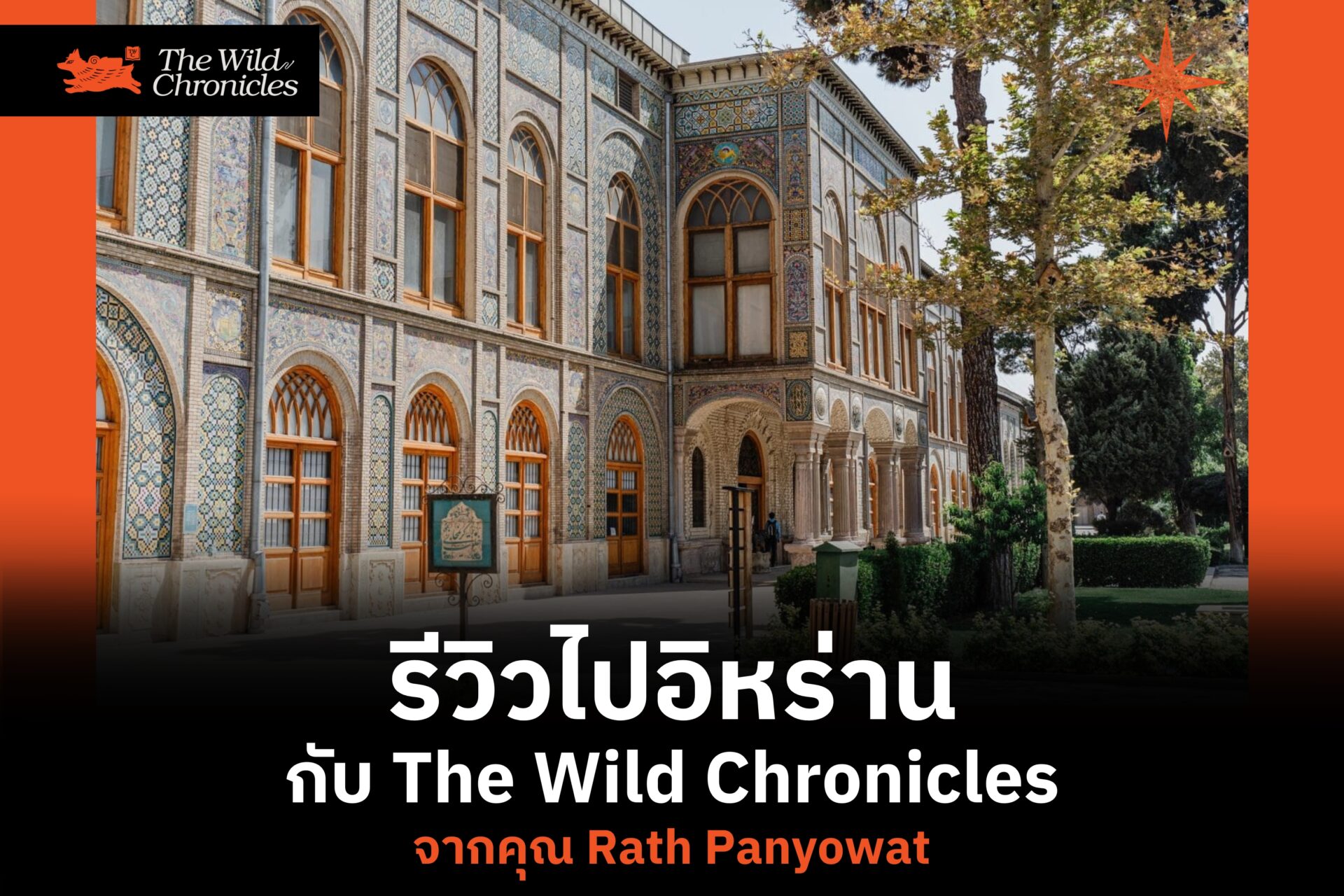
5. Mosques and Persian-style mansions. Besides their special feature of patterned glazed tiles on the walls,
they have another signature: the entrance is a deep recess called an iwan (Iwan), with a back wall and side walls, while the front is wide open.
6. The aesthetic sense of the Persians is very refined and deep. Khun Pup said that an Iranian's happiness is to sit out in the garden chatting, listening to the sound of water from fountains and pools in the garden, sipping tea, reading poetry, and smelling orange blossoms so sooooo much... It sounds like a dream, doesn't it? But it's no exaggeration.
We went in spring. The blossoms of the bitter orange tree, which people here call Naranje, were in full bloom all through the gardens, and the scent really filled the air, clean and faintly sour like orange blossom. With orange trees planted all around the long pools that run through the garden, whenever the wind blew the fragrance wafted over us. It was a wonderful atmosphere.
And when I say Iranians read poetry, whose poetry do they read?
Actually there are many famous Iranian poets. In Thailand we probably know Omar Khayyam best, but another very famous poet is Hafez (Hafez). His tomb is in a public garden and is an important tourist attraction in Shiraz. The guide said there are two important books for Iranians: the first is the Quran, and the other is the collected poems of Hafez.
7. What to eat in Iran
People here eat rice and bread like Europeans and Asians, except that their rice has long, slender grains, similar to Indian basmati.
The most popular bread, found everywhere, at every meal and on every table, is called sangak bread, or pebble bread. It isn't made of pebbles; rather, they heat pebbles until very hot, then lay thin sheets of dough on the hot pebbles until cooked through.
Vegetables include leafy greens, parsley (it looks like coriander, but is a different plant), and tomatoes, fresh, grilled, or finely mashed for cooking all sorts of dishes. There is a dish called Iran Omelette that is very like scrambled eggs and is full of mashed tomato (again, as usual).
There is plenty of fresh cheese and sheet cheese, and plenty of yoghurt, which is poured over food instead of salad dressing.
On this trip Khun Pup took us to many interesting restaurants. At some, the entrance is narrow and looks like the doorway to a basement in a murder movie, but once inside, the hall is grand and enormous.
8. The classic model of a Persian city: palace, mosque, bazaar
The centre of government in an ancient Persian city combined the dimensions of rule, of spirit and of livelihood: the palace, the mosque and the bazaar sit in the same district or close by.
In old cities like Shiraz or Isfahan (Isfahan shows this most clearly, since everything is gathered in one square called Naghsh-e Jahan Square, or simply the Shah's Square) we see the palace, the major mosques and the bazaar all located in the same neighbourhood. This square clearly consists of these three major parts: palace, mosque, bazaar.
9. What to buy?
...Coming here and not buying or shopping at all is a big sin for us Thais. But being lured into buying Made in China goods in Iran would be a bit embarrassing...
Famous products here include carpets, rosewater, rose tea, nuts, handcrafted wooden items, and books of Persian poetry. About carpets, the shop owner explained there are two kinds: carpets woven with delicate patterns are made by city people, while those with geometric patterns are woven by nomads. Our group didn't buy any.
As for roses, dried roses and rose tea are famous in Iran. Thai took the word kulab (rose) from Persian. We have used rosewater in ceremonies since ancient times, to make scented water, and filled ceremonial sprinkler flasks with it. You could say we have been importing rosewater from here since the Ayutthaya period.
Having come all this way, wouldn't you buy as our ancestors did?
10. Natural attractions, or something outdoorsy, are there any?
Yes... Khun Pup took us slightly off the route to visit a pink lake called Maharloo Lake. The pink comes from algae in the lake.
It wasn't in the original programme, because Khun Pup said the colour of Lake Maharloo is unpredictable and sometimes it isn't pink at all. But by chance that day, looking down from the plane, it happened to be pink, so we got to stop here before entering Shiraz. It is about 25–26 km from Shiraz.
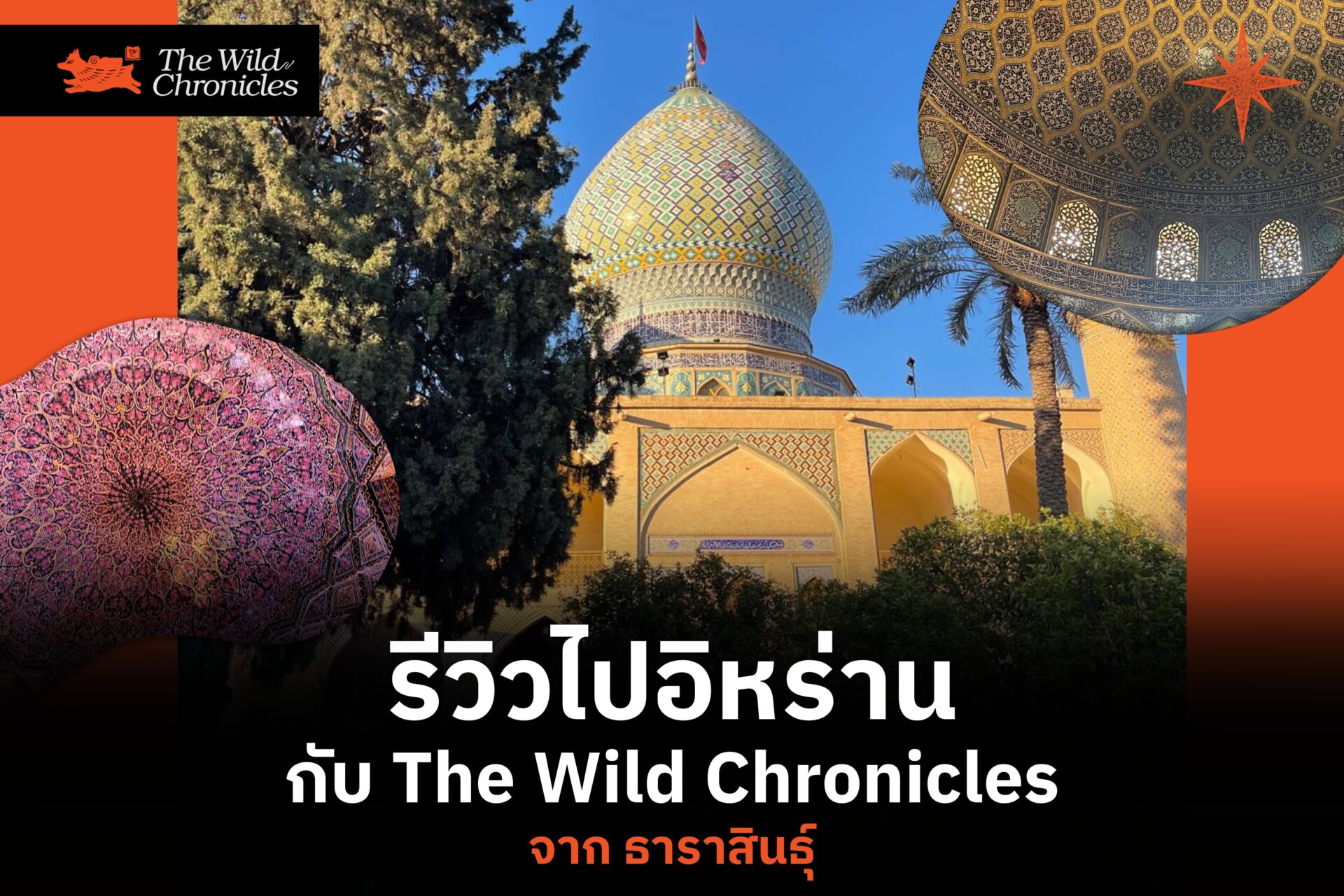
11. If you love tilework, glasswork and lavish, more-is-more patterns, you won't be disappointed by the mosques here. The patterns are exquisite and delicate, truly beautiful. Importantly, every place controls its colour theme well. For example the Shah Mosque or Lotfollah Mosque is in blue, light blue, white and turquoise: lots of pattern, yet classy. And the symmetry is the best.
12. Mirror mosques sometimes have astonishing origins. For example, in Shiraz there is the Shah Cheragh mosque, which is a thousand years old. The guide said the mirrorwork probably began about 400 years ago because the city traded with Venice in Italy, famous for glassware (I understand it was from Murano in Venice). They ordered mirrors to look into. By chance, one shipment arrived with the mirrors broken, so they adapted the pieces to decorate with, and it became beautiful mirrorwork.
13. How were the hotels?
Wow... the hotel in Isfahan arranged by the tour was so luxurious, as if I were a maharani!
The first hotel, in Tehran, was very good. The lighting was a soft strip light running around the room, the amenities were all in order, and staff left a mask and an alcohol pad in fresh plastic packaging for us every day.
Shiraz was so-so, but in Isfahan we stayed at the Abbasi Hotel, said to be the oldest hotel in the world, covered in mirrorwork, with a beautiful courtyard garden in the middle of the hotel. And we even got a suite.
14. And the people of Iran, what are they like?
...Super friendly, kind, lovely, extremely welcoming. Wherever we walked, people assumed we were Chinese and called out “Ni hao” in a row...
When we said we were from Thailand, each person smiled and said Welcome. Wherever we walked, people asked to take photos with our group.
15. Contemporary Iran: what is there to see?
Since our tour company is famous as a master of stories, history and information, we got to see many things others might not go to, such as the former American embassy in Iran. If you have seen the movie Argo, the setting was recreated in it. Iranians call it the Den of Espionage, the spies' den.
Or the war museum, which is done on a grand scale, with recreated scenes and videos telling of the cruelty of the war Iranians had to face and the hardships the martyrs endured when they gave their lives.
There are hot rooms and cold rooms, simulating the extreme heat and cold of the camps where soldiers had to dig in, waiting to face the enemy.
The museum building itself (just the building) probably covers about 10 rai, and the outside is so big you can hardly walk all of it, with replica nuclear warheads lined up in a row next to a science museum.
That ends the review of the Iran tour, Magical Palaces & Desert, which ran in 2 rounds, 8 days 6 nights each. *Round 1: 12–19 April 2024 (during Songkran) *Round 2: 26 April – 3 May 2024 (during Labour Day). If you are interested in the programme, contact us by inbox or add LINE OA @thewildchronicles (type @ in front) and write “Interested in the Iran tour”. There is a special discount right now, so book early!