FILE Nº 0667 · History · DECLASSIFIED
Why Is Bengal Split in Two? Bangladesh and West Bengal (India)
TL;DR — Many know Bangladesh was once East Pakistan, but did you know the land called Bengal itself was divided into two parts as well?
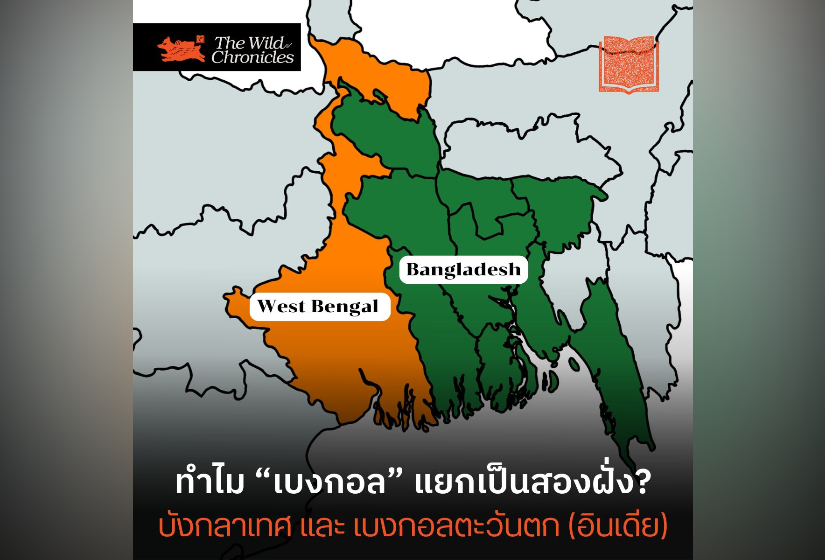
Many of you may know that "Bangladesh" used to be "East Pakistan," but did you know that the land called Bengal was divided into two parts as well? Bengal has West Bengal, which is under Indian rule, and East Bengal, which is today the country of Bangladesh.
"Bengal" lies in the world's largest river delta, in the east of the South Asian subcontinent, where the major rivers Ganges and Brahmaputra meet.
In the past, Bengal was one of the richest and most fertile lands, and it would be no exaggeration to say so. It also covered a wide area, which in today's terms comprises the Indian state of West Bengal and the whole of Bangladesh.
The people who live here are called "Bengalis." They have a strong and distinctive linguistic and cultural identity, until the Bengalis were later separated by the British Empire over the matter of "religion."
::: ::: ::: ::: ::: ::: ::: ::: ::: :::
Going back to the 18th century, the British East India Company came to this land as merchants from a distant country.
But because of Bengal's wealth as a center of textile and agricultural production, the British wanted to hold the land as their own colony. Using as a pretext that the ruler of Bengal had seized a British fort, they responded with military force and took over the land.
The key turning point was the "Battle of Plassey" in 1757, when the British army won a decisive victory over the Mughal-allied army, and the Mughal Empire had to lose its territory in Bengal to the East India Company. The seizure of Bengal became the start of Britain's conquest of the Indian subcontinent, which would take all of it within the next hundred years, and it made Bengal the "heart" of the British Raj, with Kolkata as the capital of India at the time.
Time moved on to the early 20th century. Although Bengal prospered greatly under British rule, it also became a center of intellectuals and the nationalist movement, which began to resist the ruling power.
This led to a key event in 1905, when Lord Curzon, the Viceroy of India at the time, announced a policy of dividing Bengal into two parts: West Bengal and East Bengal.
The United Kingdom used the pretext that Bengal was too large and too densely populated to be administered thoroughly, but the real reason behind it was a political strategy called "divide and rule," to weaken the Bengali nationalists. The British deliberately drew the line along religion, separating East Bengal, with a Muslim majority, from West Bengal, with a Hindu majority, so that Bengalis would quarrel among themselves.
However, the Bengalis saw through it. The matter spread from politics to every part of society. They began protesting in the councils, boycotting British goods, and organizing strikes across Kolkata.
Many students abandoned their British textbooks to join the movement to save the nation.
In the end, this enormous pressure forced the British to back down and announce the annulment of the partition of Bengal six years later, in 1911, and decide to move the capital from Kolkata to New Delhi to escape the scorching nationalist current in Bengal.
::: ::: ::: ::: ::: ::: ::: ::: ::: :::
But that victory was only a delay. The seeds of division the British had sown had already begun to take deep root as "religious politics."
In 1909 the British introduced separate electorates by religious group, so each side began to push political agendas mainly for the benefit of its own religious community. Hindu politicians began to favor Hindus, and Muslim politicians began to favor Muslims, creating mutual suspicion.
::: ::: ::: ::: ::: ::: ::: ::: ::: :::
Then in 1947 Bengal was partitioned a second time, permanently, under the partition of India, this time using religion as the criterion.
The new border of Bengal drawn by Sir Cyril Radcliffe in 1947 was strangely similar to the old line drawn by Lord Curzon in 1905. It tried to allot East Bengal a Muslim population of about 71% and West Bengal a Hindu population of about 70.8%, although the real figures deviated somewhat from the original plan.
With the partition of Bengal, the once-prosperous Bengal, where the eastern part was a fertile breadbasket producing food and raw materials to feed the industrial factories in the west, while the west produced finished goods to sell back in the east, collapsed at once. The railways, roads and waterways that had connected them were cut.
The consequences were severe, especially for West Bengal (India), which faced a serious food shortage because the best rice-growing land had fallen to East Bengal.
This crisis dragged on through the 1950s and 1960s. In 1959 alone, West Bengal faced a severe food shortage, and scenes of people taking to the streets to protest from hunger became a common sight in Kolkata.
Besides the economic crisis, the saddest thing was one of the largest mass migrations in world history. Millions became refugees. Hindus in the east and Muslims in the west, fearing religious conflict, had to leave their homes, property and family histories to cross to the other side of the border.
(Honestly, some of the Bengali leaders preferred a single independent state not beholden to anyone, because it was obvious that if the two were separated, East Pakistan would have no port city (Kolkata) and no industrial factories at all, and its economy would surely collapse.
But Indian leaders and the Hindu groups would not agree, because they distrusted the Muslims and feared that Bengal would later join Pakistan. The result, when no agreement could be reached, was that the British drew the line along religion as before, leaving East Bengal with nowhere to go but to join Pakistan, at the invitation of Jinnah, the leader of West Pakistan.)
::: ::: ::: ::: ::: ::: ::: ::: ::: :::
The eastern side (East Pakistan), meanwhile, faced a "brain drain" and a management crisis, because the existing structure of civil servants and intellectuals was mostly Hindu. When these people emigrated, the gap in power was filled by people from West Pakistan with an entirely different culture.
In its poverty, East Pakistan soon fell under the political domination of West Pakistan. Economic inequality and the oppression of Bengalis by the Punjabi elite eventually led to the struggle to separate in 1971 and the birth of "Bangladesh."
::: ::: ::: ::: ::: ::: ::: ::: ::: :::
Today, if you ask whether the Bengalis on both sides want to reunite as one as in the past, they would probably answer "no," and "it is nearly impossible."
Although they share cultural and linguistic roots, more than 70 years apart have created differences in political systems, ideologies and religious structures, with each side following its own path, so the idea of reunification is a matter of history more than a real wish of Bengalis in the real world.
Politically, Bangladesh has long been one of India's best neighbors. The two are closely joined in economics and security, and it seems this alliance will not change easily any time soon.
But then again... where politics is concerned, anything can happen. There are still petty issues like the dispute over river water that can always turn into international drama. We can only hope that neighborly ties will help them get through these headaches (or will they?).
#TWCSummary #TWCBangladesh #TWC_Salmon