FILE Nº 0403 · Travel · DECLASSIFIED
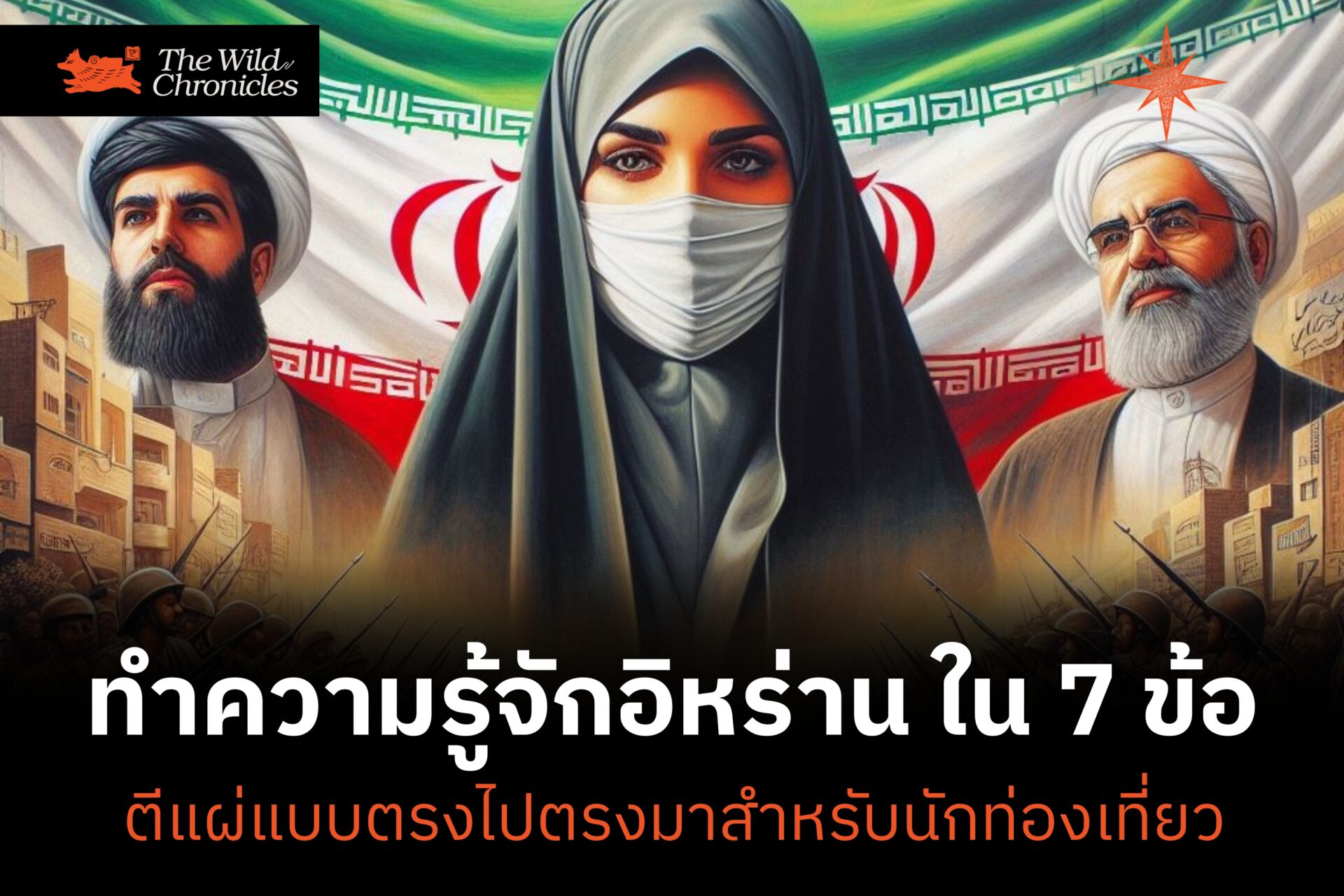
Getting to Know Iran in 7 Points: A Straight Talk for Travelers
TL;DR — Is Iran safe? Is there a war? Is it really scary? These questions come up in many minds when this country is mentioned.
Contents
... Is Iran safe? Is there a war? Is it really scary?... These questions probably pop into many people's heads when this country comes up. In this article, The Wild Chronicles lays out, straight and in 7 points, what travel in Iran is really like for tourists, based on information and long experience of traveling in Iran. Let's see how it goes...
*** 1. Go to Iran and you will definitely run into war and missiles!? ***
Answer: Not true
It is almost impossible to encounter a war situation in Iran, because American missile strikes on Iranian forces "do not happen" in Iran. They happen in other countries where Iran has extended its influence.
The conflict between Iran and America today takes the form of a "proxy war," a conflict in which neither side attacks the other directly,
but instead uses third countries as battlefields, with both sides backing their own allies to fight the rival.
Besides that, threats to fire at each other are often "psychological" warfare: when America threatens to strike Iran, Iran immediately declares it is ready to hit back. Put simply, it is a back-and-forth of threats, followed by shooting in other countries, such as Syria, Lebanon and Jordan.
If you look at the timeline of the Israel-Hamas war that began late last year, you will see that no missiles were fired on Iranian soil at all. – On 7 October 2023, Hamas launched an unexpected attack on Israel. Israel responded with ground operations and air strikes in the Gaza Strip, causing many deaths, and Israel was criticized by many parties, including its allies. – Hezbollah in Lebanon, an ally of Hamas, has fired on northern Israel from the early part of the war until now. – Another Hamas ally, the "Houthi armed group" in Yemen, after the war in Israel began, started attacking cargo ships and commercial vessels passing through the Gulf of Aden and the Red Sea, one of the world's important shipping routes, to pressure Israel to end the war in Gaza. – Also, from 12 to 22 October, Israel struck airports in Syria at least three times, especially in Damascus and Aleppo. Then on 24 October there was another strike in Daraa governorate, said to be in response to 2 rockets fired from Syria into northern Israel. – On 20 December, Syria fired 4 rockets at the Golan Heights occupied by Israel, and Israel fired back, also aiming at the Syrian army. – America and the United Kingdom jointly launched strikes on Houthi targets at several points in Yemen from 11 January 2024, focusing on military infrastructure that might be used to attack ships in the Red Sea and the Gulf of Aden. – Another group is the Islamic Resistance in Iraq, which from 2 November to 28 January 2024 attacked various parts of Israel at least 11 times, and also used drones to attack American bases in Syria 3 more times, in response to Israel's attacks on Palestinian civilians in the Gaza Strip. (Hamas, Hezbollah and the Houthis are allies backed by Iran.) – On 15 January 2024, Iran launched attacks in two neighboring countries, Iraq and Syria, and later also attacked Pakistan. – Iran claimed that the attack on Iraq targeted an Israeli intelligence command center, in retaliation for Israel having earlier killed one of Iran's commanders. The attack on Syria was aimed at bases of anti-Iran terrorist groups believed to be linked to the bombing at the memorial ceremony for Qasem Soleimani, a former Iranian commander. As for the attack on Pakistan, Iran said it hit Jaish al-Adl, an anti-Iran group in the border area between the two countries. – On 28 January 2024, Iran-backed armed groups in Iraq and Syria sent drones to attack an American base in the northeast border area of Jordan, next to Syria, killing 3 US soldiers and wounding at least 34. – On 2 February 2024, America launched air strikes in Iraq and Syria in response to the Iran-backed armed groups, killing one of the groups' commanders.
– On 20 February, the Houthis did not stop, using missiles to attack 2 American ships in the Gulf of Aden, and then firing 2 missiles at a humanitarian aid ship heading to Yemen.
...As you can see, within the conflict across the whole region, there have been no clashes inside Iran itself, just as there have been none inside America, the leader of the proxy war on the other side...
This standoff between Iran and America has gone on for decades. America does not think a direct war with Iran is worth it, and neither does Iran, so both merely issue condemnations and occasionally launch covert attacks on the other side's bases, to intimidate and show off their military power to their own people.
Besides, Iran's main tourist routes are not risk points for clashes at all... so traveling in Iran has nothing to do with these matters, just as traveling in America has nothing to do with them.
*** 2. Iran is unsafe? Lots of snatch-and-grab theft? ***
Answer: Not true
Iran is a very safe country, partly due to strict law enforcement, which results in a low crime rate. We can walk the streets with peace of mind and feel no threat from locals, and this is true in every city in Iran.
One interesting example comes from an article by Tiago and Fernanda of Mondayfeelings, who told of their experience living in Iran for a full month:
"Iran is one of the safest countries we have ever been to. We walked around at night and never had any problem. We also used our mobile phones on public transport. We know that in most European countries this might sound silly, but you really cannot do this in Sao Paulo." (because you would be robbed)
*** 3. The Iranian government is above everything. You will be arrested and unable to leave the country!? ***
Answer: True, but not entirely
Iran's government has been a semi-authoritarian system led by religious leaders since the Islamic Revolution of 1979.
...However, it is impossible for you to be arrested if you have not done anything illegal...
The foreigners who have been arrested did something seriously against the rules without heeding warnings, such as flying a drone over a military site or sneaking into Iran across the border without permission. An offense of that kind would get you arrested in any country.
As for female tourists, they do need to dress modestly and wear a headscarf, but in my experience (Pap, the author here) this rule is not strict. A local police officer will politely warn you (they do not charge a fine). Once you comply, the officer thanks you and leaves. I have been dozens of times and have run into this only once.
If you do everything lawfully and behave normally, I guarantee you can be at ease about everything.
*** 4. Iran is a haven for terrorists!? ***
Answer: Not true
Today, when people speak of terrorists, one meaning is terrorist groups with a Salafi global jihadist ideology, such as Al-Qaeda or ISIS. Another meaning is a political slur, used to blacken governments or political groups we dislike.
Of course, Iran is called a "terrorist state" by many parties, but the governments of many countries, such as Israel, China, Russia, America and even Thailand, also have people who are called "terrorists," because having political enemies is normal.
Iran itself is in fierce conflict with the terrorist groups ISIS and Al-Qaeda, because Iran follows Shia Islam, while those terrorist groups are hardline Sunnis. So Iran has nothing to do with Salafi-line terrorist groups at all.
*** 5. Iranians are radical Arabs!? ***
Answer: Not true
This accusation is deeply unfair, because they are not Arabs. They are "Persians," rooted in the great Persian civilization going back thousands of years.
The Persian Empire was one of the greatest and oldest empires in history. Later Iran was taken over by Arab rulers in the 7th century, and the Arabs took Iranian culture and spread it to the world. Put simply, much of what we think of as "Middle Eastern" is connected to Iran, such as the Persian arch, garden design, food, fragrances and clothing.
For this reason Iran is deeply proud of its culture and its Persian identity.
In addition, they follow "Shia" Islam, which differs from the Arabs, who follow "Sunni" Islam.
*** 6. Iranians are scary, closed off and unfriendly!? ***
Answer: Not true
...Completely wrong. Iranians are certainly among the friendliest peoples in the world...
They are typically kind-hearted, generous, hospitable and ready to welcome tourists. Most are modern-minded, and they are very proud to share their culture with the world, which always impresses their guests.
From my experience of visiting Iran many times, they welcome guests with generosity and friendliness.
From the experience of someone who has visited Iran, Kunjira P, who once said:
"The most surprising highlight of Iran is the people. They are so nice, so endearing. They know that the whole world sees their country as unsafe and sees them as scary, from distorted communication through the news of the free world. So when they see tourists come to their home, they are deeply touched. Many people walked up to thank me for coming, for keeping an open mind, coming to ask for a handshake, a hug, a photo, and say thank you. Sob. #ใจเหลววววว"
Even Americans, who are like their political opposites, are welcomed as special guests, as in the case of Jackie, owner of the blog Bohemianvagabond:
"I felt very safe traveling in Iran, more than in most places in the world. When they meet American tourists in Iran, they are amazed and seem honored. They are sincere and hospitable, and the men are not physically or verbally aggressive, which made me feel safe and comfortable."
Not only that, she also encourages American travelers to visit Iran, saying: "I welcome and challenge you to visit Iran. Many people who have been come back saying only good things about Iran. There are so many aspects that are reasons to visit Iran at least once."
*** 7. An Iranian visa is hard to get, and after going to Iran you can't go to the USA!? ***
Answer: Not true
An Iranian visa is very easy to get. It can be done in 2 weeks to 1 month, and there is even visa on arrival (though you need to apply for permission a little in advance).
The Iranian visa is not stamped in the passport, so there is no cross-country record search.
The belief that getting an Iranian visa makes it hard to go to America comes from the past, when Iran still stamped passports, and American visas came in two types, long and short. If you were from a developed country or a country America approves, you got the short type of visa, but if you were eligible for the short type and had been to Iran, you would be pushed over to the long type.
For Thais, we are in the long type anyway, so it has no effect. And as mentioned, since Covid, Iran no longer stamps passports, so going to Iran has no effect at all on applying for an American visa. People who want to visit both countries can relax.
::: Summary :::
In world politics, the news media are divided into 2 main sides: the "free world side," such as America, the United Kingdom and Japan, with Thailand also on the free world side, and the "non-free-world side," such as China and Russia, and Iran too, and the two sides try to fight each other.
Free-world media (mainly American) tend to portray Iran as the "villain" behind every terrorist group, focusing on nuclear weapons, religious fanatics, human rights abuses and dictatorship. It must be admitted that the influence of these media is very strong in the free-world camp, including Thailand.
But I am not saying free-world media are bad. Media on the non-free-world side also present very biased news in their own favor, for example when Iranian media talk about America they often curse it with bias.
Honestly, I think free-world media are even more credible than the other side, because each outlet is balanced by competition on quality. However, I want to point out that there is competition in information, and going to Iran, or listening to the Iranian side, will help us understand the viewpoint of the side opposite to our mainstream media.
As said before, Iranians are very friendly. They are ready to welcome you, and are very excited to see foreign tourists visiting their country.
This is a case of "seeing is believing" (literally, "ten mouths cannot beat one eye"). If readers get the chance, I hope you will come and see it for yourselves.