FILE Nº 0417 · History · DECLASSIFIED
A Short History of Andorra: The Tiny Nation That Escaped Being Swallowed by France and Spain
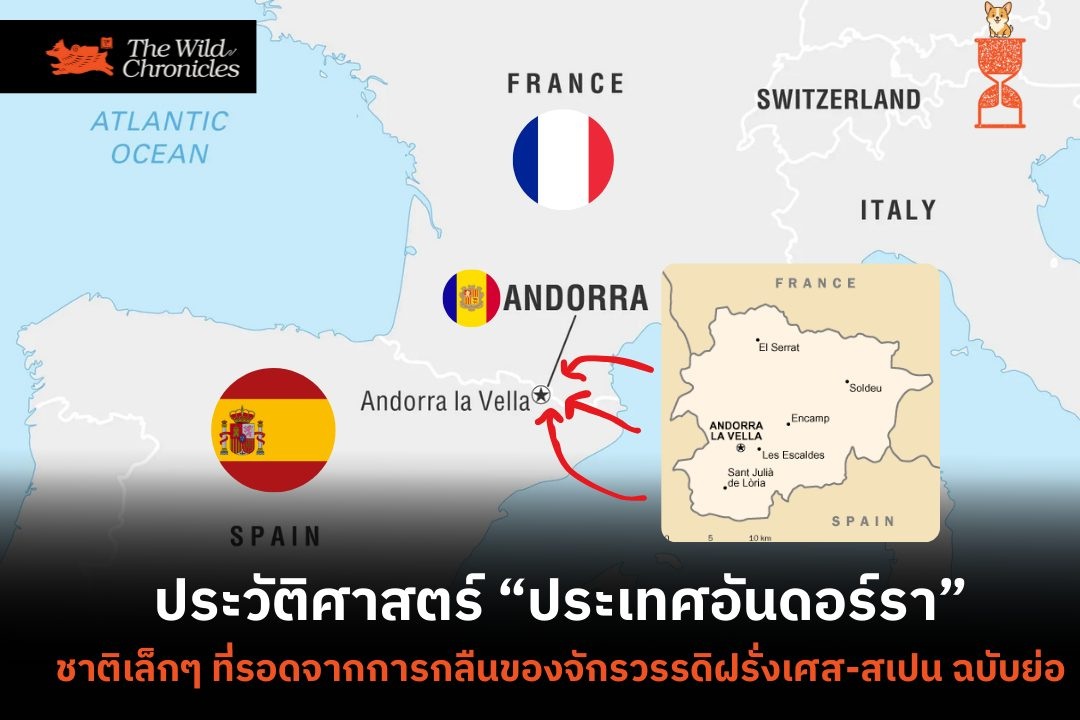
TL;DR — Andorra is a tiny country hidden in the Pyrenees in southern Europe, bordering Spain and France.
Andorra is a tiny country hidden in the heart of the Pyrenees in southern Europe, bordering Spain and France. It has a population of only about eighty thousand, yet it has kept its independence for more than a thousand years.
The country has a strangely unusual system of government, because it has two co-rulers of the state!
"Andorra" may not be a name many people are familiar with, but the history of this principality is every bit as fascinating as that of any large country.
From ancient times, this valley land was just part of the borderlands of old kingdoms.
Then came the Middle Ages, with their wars and agreements, and the birth of a unique system of two co-princes on two thrones,
which in time developed into a modern democratic state.
This article takes you back through the valleys and the centuries of Andorra, telling the story era by era,
to find out how such a small country formed itself and kept its independence amid the great historical currents of the empires of Europe.
Come along with us..
________________________
Born from invasion
The war over Andorra and the sharing of power
A joint rule like no other
The voice of the people between two thrones
Andorra's transition to democracy
The Principality of Andorra
The Principality of Andorra today
________________________
Born from invasion
1. In ancient times Andorra was not yet a country as it is today, but a remote valley where native tribes lived amid quiet nature.
2. As time passed, the area came under the influence of various civilizations that spread into it, whether the Visigoths, who ruled the Iberian Peninsula after the fall of the Roman Empire, or the Franks from the north. All of them left cultural traces in this small valley.
3. A key turning point in the early period came with the invasion by Muslim armies of Arabs and Berbers under the Umayyad dynasty. In the 8th century they pushed up to the Pyrenees, and many Christians fled the war to hide in deep valleys such as Andorra.
4. Local legend tells that Charlemagne, emperor of the Franks, led an army to free this region from Muslim occupation, and to use Andorra as a buffer zone to stop Muslim armies from advancing into northern Europe again.
The legend goes on to say that Charlemagne granted a charter, in some tellings called the "Charter of Foundation" (Carta de Fundació d'Andorra), giving independence to the Andorrans in return for their help in the war.
5. Although the historical evidence for this charter is hazy and it may be only a legend, the story has become part of the Andorrans' own identity, and Charlemagne's name even appears in the lyrics of the national anthem.
6. After Charlemagne's time, Andorra remained in the shadow of the Frankish empire. His grandson Charles the Bald assigned the Count of Urgell to govern and look after this valley land.
7. Later, the count's descendants gave the rights over Andorra to the Bishop of Urgell in 1113, and the Church of Urgell took on a role in caring for the area in the name of the Catholic Church.
8. This transfer of power placed Andorra under the protection of the Bishop of Urgell in Catalonia, but at the same time secular nobles from neighboring regions were also eyeing the chance to gain influence over the territory.
________________________
The war over Andorra and the sharing of power
9. After Andorra came under the Bishop of Urgell, the struggle for power over this little land was still not over. The Counts of Foix, who ruled lands on the French side, also claimed rights over Andorra, and in 1159 the conflict erupted into fighting between the Bishop of Urgell's side and the Count of Foix's side for control of Andorra.
10. The wars and disputes dragged on for decades. The rugged terrain of the Pyrenees valleys made Andorra a natural fortress, and any invader faced great difficulty in taking the land.
11. Meanwhile, the Andorran villagers lived in constant fear of when their traditional rights and freedoms might be taken away. In the end, the conflict was settled by a negotiated compromise rather than continued armed confrontation.
12. In 1278 both parties signed an important treaty called the "Pareatge". This treaty was like a feudal charter that recognized the standing of both sides as equals, and, most importantly, agreed to share sovereignty over Andorra jointly.
13. The result was the birth of a "co-principality" system unlike any other in the world. From then on, Andorra did not belong wholly to either side, but was ruled side by side by two co-princes under the 1278 agreement.
14. The powers and duties of the two co-princes were divided in an interesting way. The Bishop of Urgell was recognized as holding sovereignty over Andorra in "spiritual and ecclesiastical matters", while the Count of Foix, a secular nobleman, received "political, judicial and military power".
15. One could say that one was like a religious leader and the other a worldly leader. Andorra, once a land fought over, thus became a buffer territory, which both France and Spain jointly watched over to make sure neither side gained total control.
________________________
A joint rule like no other
16. At first, the Bishop of Urgell and the Count of Foix were co-princes in practice. Each ruled Andorra through his authority within his own sphere, and each received a small tribute from the Andorrans in return for acting as protector, such as agricultural produce or a sum of money each year.
17. Under the feudal system of Europe at that time, the Andorrans accepting the protection of two lords like this was a price well worth paying, because it meant they would not be annexed and absorbed outright by either neighboring power. Andorra remained in practice a free community, even though it had two foreign rulers.
18. It is notable that this co-principality system endured through the many changes of Europe. The House of Foix itself changed politically: an heir of Foix married into the royal house of Navarre in Spain, and later Henry of Navarre, known to us as King Henry IV of France, took the French throne in 1589. This meant that he also inherited the title Count of Foix by blood, which formally united the position of "Lord of Andorra" with the French monarchy from the early 17th century onward.
19. King Henry IV issued a decree in 1607 setting that the "head of France", whether king or later national leader, would hold the position of co-prince of Andorra in succession to the Counts of Foix, on an equal footing with the Bishop of Urgell on the Spanish side.
20. In other words, however the French system of government changed (from monarchy to empire or republic), the supreme leader of France has always taken the role of "prince" of Andorra alongside the Catalan bishop.
Today the French co-prince is the President of the French Republic.
The Spanish side remains the Bishop of the Diocese of Urgell, without a break, since each new bishop takes over the position automatically.
________________________
The voice of the people between two thrones
21. Although two co-princes governed, the Andorrans were not passive or simply waiting for orders from their rulers. Their traditional social system was one of small communities that already governed themselves together. Within the framework of the co-principality, they were able to keep a good deal of their customs of local self-government.
22. The Council of the Land (the native assembly) was first established in 1419 so that village representatives could take part in running the principality. It is one of the oldest community deliberative councils in Europe, although the power to make major decisions still remained in the hands of the two co-princes.
23. This council also served to voice the opinions of the Andorrans and managed public affairs as it was assigned. One could say that, in the shadow of the two thrones, the Andorrans still had some room for a voice of their own.
24. However, after several hundred years had passed, in 1866-1868 both the Bishop of Urgell and the French leader, Emperor Napoleon III, agreed to proclaim the "Nova Reforma" ("New Reform") to make Andorra's system of government and administration more efficient and modern.
25. This reform was the first milestone in the change from the feudal system to a new age, whether in the organization of tax collection, the administration of justice, or opening the way for greater economic development. It let Andorra begin to connect with the outside world little by little.
________________________
Andorra's transition to democracy
26. On entering the 20th century, Andorra, once utterly quiet, began to change with the times. Advances in transport meant this land in the middle of the valley was no longer as isolated as before. People learned of news and new ideas from the outside world, such as the democratic ideals then spreading everywhere. The Andorran people themselves began to want more of a say in government, rather than leaving all important matters to be decided by the co-princes and a few elites.
27. Political tension arose from time to time. In 1933, for example, protests and unrest broke out within Andorra over an election, and France, then governed by a republican government, even sent in forces to control the situation temporarily.
Two years later something odd happened when Boris Skossyreff, a Russian adventurer, declared himself "King of Andorra", claiming he would modernize the country. He proclaimed himself king through a document announcing a new constitution, handed out free, and asked the villagers to endorse him. His imposture lasted only 8 days, ending when the Spanish authorities arrested him and expelled him.
28. These events show well the demand for change within Andorran society. Moreover, from the Second World War onward, Andorra began to develop by leaps and bounds from a poor land into a modern society. Tourism grew, roads cut through the mountains to reach it, and shops and businesses began to spring up. This prosperity gave the people a higher level of education and made them aware of their rights, and the call for democracy grew firmer throughout the valley.
29. As a result, in 1970 Andorra began to widen political rights, for example giving women the right to vote, and local councils and the civil service were updated to be more modern. Then on 15 January 1981 came another important milestone, when the two co-princes (France and Spain) jointly signed a decree formally establishing the Andorran government.
30. This gave the little principality an executive branch clearly separate from the General Council, and it began to run the country more by itself, with the head of the Andorran government as its first leader. The result of this structural change was a reduced role for the co-princes in day-to-day affairs, and a path toward sovereignty held more by the people.
31. Even so, the biggest transition came in the early 1990s, when the people's demands reached their peak. Andorra held a referendum in March 1993 so that the people could vote on the draft of the country's first constitution.
In that historic referendum, most people voted in favor, and the new constitution was officially proclaimed on 28 April 1993. Andorra was born again as a full democratic state.
________________________
The Principality of Andorra
32. The 1993 constitution set that sovereignty truly belongs to the people. Members of parliament are elected, and the legislative, executive and judicial powers are clearly separated.
33. Although the two co-princes still remain joint heads of state according to a tradition handed down for more than 700 years, their roles are limited within the constitutional framework. They no longer have the power to go against the will of an elected government.
The roles of the two present co-princes are limited to ceremonial duties, such as appointing the head of government according to the majority in parliament, signing treaties, and serving as symbols of the state.
One could say that Andorra has made the transition to a true "democratic principality". After the new constitution was proclaimed, Andorra stepped onto the international stage in an official way.
34. The United Nations admitted Andorra as a member in July 1993, and it joined the Council of Europe in 1994.
________________________
The Principality of Andorra today
35. Stepping into the 21st century, Andorra's image has changed greatly from the past. From a small, isolated farming community in the middle of a valley, Andorra today has become one of the most prosperous and stable countries in Europe.
36. Andorrans enjoy an excellent quality of life. Average life expectancy is around 83-85 years, which ranks among the best in the world, while the literacy rate is as high as 100% according to UNESCO, reflecting a strong education system. People are able to speak three languages (Catalan, French and Spanish).
37. Andorra's economy has also grown rapidly from tourism and service businesses. Millions of tourists flock each year to experience nature and ski on the snowfields of the Pyrenees, and to shop for duty-free goods in the little capital full of stores and shopping centers. As a result, Andorra has one of the highest GDPs per capita in the world.
38. Although not a member of the European Union, Andorra uses the euro as its currency and ties its economy closely to Europe. Its financial and tax policies have been adjusted to be more in line with international standards.
39. Andorra also strongly preserves its traditional culture. Catalan is maintained as the country's only official language, which makes Andorra the only country in the world that uses Catalan officially.
40. However long time passes, the Andorrans remain proud of their distinctive identity, including their culture, national costume, local festivals, and the historical heritage passed down through the Charlemagne legend and the ancient system of co-princes. And Andorra continues to stand proudly in this land of mountains.
______________________________
Image reference : cdn(ดอท)britannica(ดอท)com/80/183580-050-27967853
/World-Data-Locator-Map-Andorra(ดอท)jpg
#TWCHistory #TWCAndorra #TWCSpain #TWCFrance #TWC_Salmon