FILE Nº 0447 · History · DECLASSIFIED
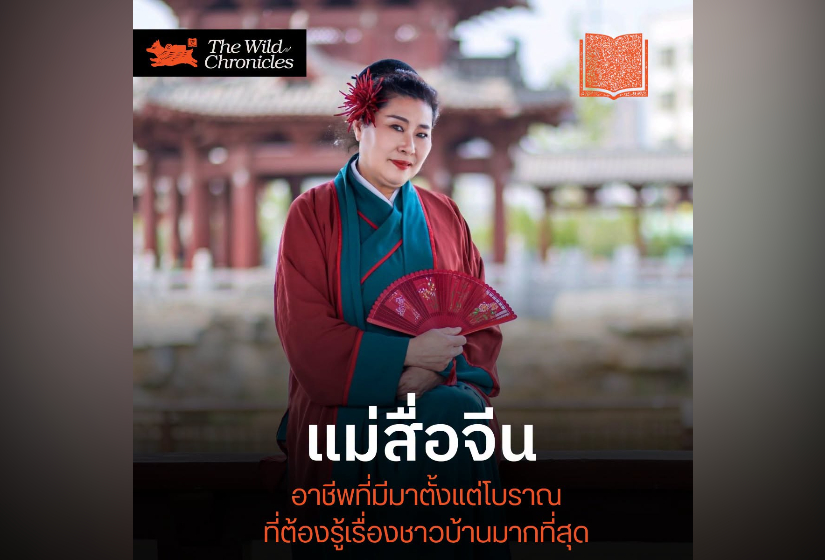
The Chinese Matchmaker: An Ancient Profession That Had to Know Everyone's Business
TL;DR — How did people court each other in the old days, before apps like Tinder, Omi or CMB? I'm sure everyone has wondered!
How did people court each other in the old days? In an era before apps like Tinder, Omi or CMB, I'm sure everyone has wondered about this!?
Some knew each other from childhood, some met at school, some met and simply walked up and started courting. There were many ways..
But did you know that the ancient Chinese took marriage very seriously? It was not just about love; the couple also had to be a suitable match. There is even a proverb:
“Just as there is no rain from the sky without clouds, there is no marriage on earth without a go-between matchmaker”
.
(天上无云不下雨,地上无媒不成婚)
::: ::: ::: ::: ::: ::: ::: ::: ::: ::: ::: ::: ::: :::
Chinese has a great many names for the matchmaker, such as Fake Ren (伐柯人), Bing Ren (冰人), Bao Shan (保山), Hong Niang (红娘) and Yue Lao (月老).
In the past, a Chinese marriage almost could not happen without a matchmaker, because Chinese people regarded surnames and family lineage as very important. The matchmaker checked the background of both sides, whether surname, relatives, social standing or family reputation, to reduce the chance of marriage between relatives and to assess whether the two families were suited to become in-laws.
The matchmaker also coordinated, arranged the meeting of the couple, and negotiated between the two families. Even when the young man and woman already liked each other, they still relied on the matchmaker to carry out the customary steps.
A recognised marriage had to go through a proposal made by the matchmaker and have the approval of both families before it counted as a valid marriage under ancient Chinese custom.
::: ::: ::: ::: ::: ::: ::: ::: ::: ::: ::: ::: ::: :::
The matchmaker has a history of several thousand years, going back to ancient China, and was divided into “official matchmakers” and “village matchmakers”.
Since the Zhou dynasty, the government had set up the post of “Meishi” (媒氏), an official in charge of the people’s marriages, who was regarded as the formally appointed “royal matchmaker”.
The matchmaker’s duties went beyond pairing men and women. They also announced that men and women of marriageable age should meet during the spring festival, recorded the people’s marriage information, regulated the amount of bride price, handled marriage disputes, and punished those who violated state rules.
Village matchmakers, on the other hand, worked outside the bureaucracy. They acted as go-betweens for proposals and coordination between the two families, and helped carry out wedding ceremonies according to custom. Those who worked as professional matchmakers were paid for pairing up the bride and groom.
::: ::: ::: ::: ::: ::: ::: ::: ::: ::: ::: ::: ::: :::
I can't explain the matchmaker’s methods very precisely, because they were not fixed and depended on each person’s own way. But mainly, the matchmaker would check that the social standing was suitable, arrange a meeting, read faces (physiognomy), or talk with the parents of the man and woman.
.
( From what I have heard, matchmakers rarely got it wrong. People in the old days did not see love the way people do today )
::: ::: ::: ::: ::: ::: ::: ::: ::: ::: ::: ::: ::: :::
A famous matchmaker from the past is “Granny Wang” (王婆), a legendary scheming matchmaker.
(She appears in the novels Water Margin and Jin Ping Mei)
Granny Wang was from Qinghe County, Shandong Province. In her youth she was fairly good-looking, but at heart she was cruel and ruthless. She had one son, but he went to seek his fortune around the Huai River and lost contact, vanishing without a trace.
Granny Wang ran a tea shop at home, living next door to “Wu Dalang” (the husband of Pan Jinlian), and had side jobs as a matchmaker and a midwife.
The story begins when she took a bribe from “Ximen Qing”, a young playboy of means, and acted as a matchmaker who spotted the opportunity, planning, approaching and leading “Pan Jinlian” into a secret affair with Ximen Qing.
But when the affair was about to be exposed, Granny Wang was the one who plotted and urged the two to poison Wu Dalang to death cruelly!
In the end the truth came out. Granny Wang was severely punished by the magistrate of Dongping, who had her paraded in disgrace on a wooden donkey and then put to death by a thousand cuts…
::: ::: ::: ::: ::: ::: ::: ::: ::: ::: ::: ::: ::: :::
Matchmakers still exist in China today, especially in China’s matchmaking markets, where many Thais have filmed vlogs in various cities. You can go and look these up.
And one that was a trend a few years ago is “Auntie Wang” (named after Granny Wang from the novels above), a performer in the ancient city of Kaifeng, whom you have probably seen or heard of, with her fun, friendly way of talking and her live on-the-spot matchmaking that is easy to get drawn into.
Finally, whichever way you look for a partner, please keep each other’s love and feelings first.
P.S. Next year, The Wild Chronicles will be running a Shantou-Chaozhou tour in China, in March or April 2027. This will be a relaxed tour with a chilled-out program, suitable for all ages and especially for older travellers.
.
If you are interested, message our Line OA and type “Interested in the Shantou tour” to receive the tour program in advance.
#TWCHistory #TWCChina #TWC_Salmon