FILE Nº 0537 · History · DECLASSIFIED
A History of the Nomads of the Steppe: “Enemies of Civilisation”
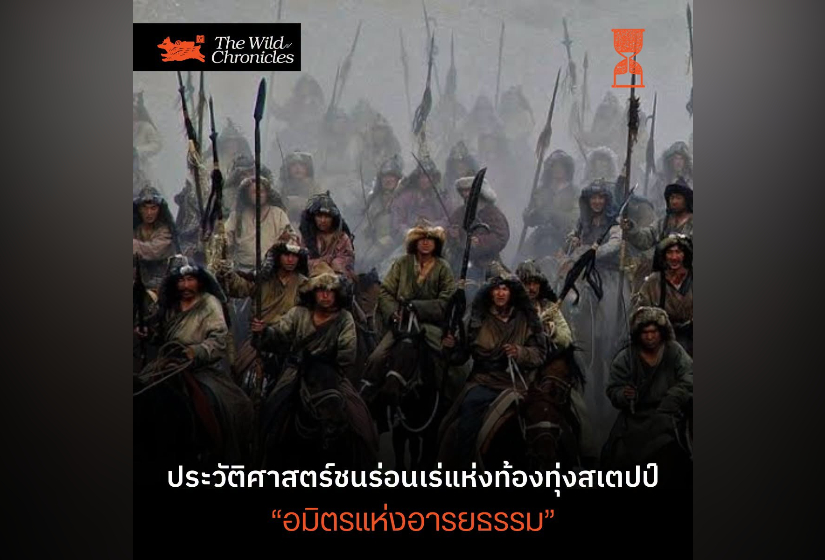
TL;DR — If you have studied world history since ancient times, you will be familiar with a theme that appears again and again in the historical record.
If you have studied world history since ancient times, you will be familiar with a theme that appears again and again in the historical record: the invasions of nomadic peoples. Familiar names include the Scythians, the Xiongnu, the Huns and the Mongols.
.
The events are quite similar. Suddenly, a previously unknown tribe from the steppe grasslands, extremely skilled at fighting on horseback, would attack the great kingdoms, winning wherever their armies marched, until those kingdoms collapsed or suffered enormous damage. Sometimes they set up vast empires of their own, but before long they faded from the pages of history, as if they had been born to be a “bringer of doom”. Some kingdoms that had lasted a long time simply vanished.
.
But what caused these nomads to arise and invade great kingdoms, becoming events of world importance? Who were they and where did they come from? And do they still exist today? Follow along in this post.
.
1. First, let me describe the geography of this “steppe”. The steppe is a vast stretch of land linking Manchuria in the east to Hungary in the west. It is very easy to travel across, with almost no natural barriers in the way.
The downside of the area is that, although it looks like green grassland, it is actually very short of rain and rather short of water, and is not suited to farming. So since ancient times, people here have lived by roaming with their livestock, moving on to wherever water was plentiful.
.
2. The part of the steppe worth noting is the eastern steppe, bounded by the Altai Mountains in the west and the Greater Khingan range in the east, which surround the Mongolian region.
This area is high, colder and drier than the western half, and has very unstable temperatures. So the people born here were pushed to look for ways to migrate out. There were two main routes: south and east (into China and Manchuria), and west (to the western steppe).
.
3. This long-standing migration is also one hypothesis for the origin of the Indo-European language family. The reason people living more than half a world apart speak languages of the same family is probably that people migrated out of the area linking the two regions, which is this very steppe. This is thought to have been around 4000-1000 BC (compare with the Sumerian cuneiform script, which appeared around 3300 BC).
.
4. Another interesting point is how the nomads’ way of life made them good fighters. They were probably among the first to raise and ride horses, around 4000 BC. In addition, because they had to defend their livestock against packs of predators, they needed skills such as archery.
.
5. Another danger of the nomadic tribes was that they could unite into “confederations”, in which many tribes accepted a single leader as chief. So the times when they could attack great kingdoms were often the times when these tribes were united and could gather large numbers of warriors (but because such unions were tied to one person, they often fell out with each other before long).
.
6. The development of fighting on horseback and iron weapons around 900-700 BC made these nomads enemies that settled peoples found hard to deal with. Fighting horses often requires horses, but settled peoples could not keep as many horses as nomads (they grew little grass and had to share their food with people, while the nomads lived on grassland where they could already keep many horses).
.
7. The first famous tribe was the “Scythians”, who appear in Greek records as controlling the grasslands around Ukraine, and who had a part in the fall of the Assyrian Empire (2025-609 BC) after plundering the capital at Nineveh!
According to Herodotus, they claimed to have come from the Altai Mountains, which led modern historians to suppose that they were the same people who destroyed the Western Zhou dynasty (1046-771 BC)! (The Chinese recorded them as the “Quanrong” (Quǎnróng).)
.
8. Another thing to note is that after the Quanrong, Chinese records do not mention many attacks by the “tribes beyond the pass” from the Mongolian grasslands until they became a chronic problem from the 4th century BC. This may support the hypothesis that the Quanrong migrated west and became the Scythians of eastern Europe.
.
9. The Persians also faced the problem of nomadic tribes. Cyrus the Great even died during a counter-invasion into the nomads’ territory, while Darius the Great turned instead to hiring tribes along the border to defend it for him.
.
10. While the Scythians were a major headache for the peoples of the Middle East, near China the “Xiongnu” (3rd century BC to 2nd century) arose as another confederation. They were fairly well organised, and fought and rested by turns with the Chinese, who at that time were under the Han dynasty.
But the rise of the Xiongnu forced other tribes (Indo-European groups) to migrate away, and some fled as far as northern India and the Danube in eastern Europe… while the empty space, present-day Central Asia, was taken over by a new group, the Turkic peoples.
.
11. One group that migrated south was the “Parthians”, who replaced the Seleucid Empire, the Greek kingdom of one of Alexander the Great’s generals, and were able to fight off migration southward by other tribes, so migration went west instead. One tribe was the “Sarmatians”, who began attacking the Romans along the Danube, but they were still few in number, so Rome could still hold its frontier.
.
The Parthians, and later the “Sasanians”, who arose in this area, blocked the way for nomadic tribes to migrate south for several hundred years, until a new tribe called the “Huns” launched a major offensive on the western steppe, driving out the Sarmatians and the “Goths” who had been there before, and bringing them under their rule.
.
12. Under a strong leader, “Attila”, the Huns and their subject tribes did heavy damage to the Western Roman Empire, which led to its collapse. After that, Germanic tribes ruled western Europe (for example the Franks, Visigoths, Burgundians, Frisians and Anglo-Saxons)… while the Hun confederation also collapsed not long afterwards, after its subject tribes rebelled.
.
13. Later, in the 6th century, the “Göktürk” confederation arose on the eastern steppe. They raided Chinese territory and sparked the reunification of China under the Sui and Tang dynasties, and were also the cause of a new wave of migration toward eastern Europe (the route through Iran was still blocked), giving rise to several tribes with names in European history, such as the Avars, Bulgars, Khazars, Pechenegs and Magyars.
Some, such as the Avars, settled down as ancestors of today’s Hungarians, as did the Bulgars, who are ancestors of the Bulgarians, while the others soon collapsed.
.
14. In the 9th-10th centuries, the peoples of eastern Europe were better able to protect themselves by developing their own cavalry forces, and the frontier on the Iranian side weakened, so the nomads’ migration route shifted from eastern Europe to southward through Iran.
This Turkic migration led to a great deal of cultural exchange among Turkic, Arab and Persian peoples, and to the arrival of the Turks as warriors who expanded the Islamic realm in place of the Bedouin Arabs.
.
15. One of the Turkic tribes that migrated down through Iran was the “Seljuks”, a Turkic tribe that settled in Asia Minor, or present-day Turkey, while another branch invaded India and waged wars of expansion until it ruled all of it in the 17th century. This Turkic expansion was one of the causes of the First Crusade, which aimed in part to reverse the decline of the Christian kingdoms.
.
16. Later, in the 13th century, a branch of the Seljuks called the “Ottomans” took over the wars against other religions in place of the Seljuks, built a great empire and lasted until after the First World War.
.
17. In the 12th-13th centuries, a nomad leader called “Genghis Khan” arose. He grew up without a tribe to back him, but relied on a bureaucracy and on appointing people by ability, systems taken from the nomadic kingdoms north of China before him (such as the “Jurchen”), and conquered vast territories to become the largest land empire the world has ever seen. It can be called the peak of the nomadic peoples.
.
18. The strong Mongol age was also an age of peace with lively trade along the Silk Road. The transfer of gunpowder, the compass and printing technology from China to Europe happened in this era (but the overland Silk Road was closed after the fall of Constantinople in 1453)… However, the Mongol Empire lasted only 2-3 generations before collapsing too, because of internal division.
.
19. After the Mongol era there were still some nomad empires, such as the Timurids, the Mughals, and even China’s Qing dynasty, which came from the Manchus, a nomadic people of the steppe.
But it can be said that after the Mongol era, the nomads entered their decline. The key reason was the development of the personal firearm, a weapon that could decisively beat horse archers. There is also another hypothesis that the bubonic plague that hit Europe hard in the 14th century may have struck the steppe hard for several centuries, greatly reducing the population.
.
20. The settled peoples around the steppe began to take over the area, especially the Russians, who expanded all the way to the eastern Pacific coast and down into Central Asia, while Qing China took over Mongolia.
.
21. In addition, the nomadic way of life was changed by the policies of colonial powers, such as Russia and the Soviet Union, which turned Kazakhstan into large-scale farmland, especially in the Khrushchev era, and Manchuria, one of the steppe areas, where Chinese settled and farmed. Although the Russian Empire, the Soviet Union and the Qing dynasty have all collapsed, the approaches adopted since then remain.
.
22. Today, some people still live a nomadic life in Mongolia and Central Asia, but they face problems including climate change, which once caused a severe winter that killed millions of livestock in Mongolia, so that in the end they have had to turn increasingly to working in big cities.
…In the end, after thousands of years of clashes between nomadic tribes and settled peoples, the settled side won. Now the nomadic way of life is disappearing, and it may remain only in the pages of history!
#TWCHistory #TWCMongolia