FILE Nº 0674 · History · DECLASSIFIED
Clash of the Steppe Horse Tribes: The World Nomad Games
TL;DR — We know the Olympics and SEA Games, but there is also a great sporting festival of the horse-riding nomad tribes of Central Asia.
We are used to great sporting festivals like the Olympics, the SEA Games and other international games watched by huge audiences around the world.
But did you know there is also a great sporting festival of the nomadic horse-riding tribes of Central Asia, with more than 3,000 athletes from over 102 countries taking part?
The sports in this festival are unlike any you have watched before, because they are the sports of nomadic tribes, raw, wild and faithful to the original roots handed down over hundreds of years. This is the World Nomad Games.
The games feature many fascinating sports, such as kok-boru, or goat polo, mounted archery, nomad-style wrestling and many more.
This is a sporting festival made especially for the finest of the tribes, to prove which nation is the strongest of them all.
It is a sporting festival like no other, and hard to find today.
What are the World Nomad Games? Follow along with me...
________________________________________
🐎 Origins
🐎 The sports of the games
🐎 A cultural space
🐎 Problems to consider
🐎 A modern sporting festival
________________________________________
🐎 Origins
1. In 2010, in a small country in Central Asia with no outstanding natural resources or large economy, where development was concentrated in a few cities, especially the capital, and which, despite its beautiful and enchanting landscape, was still unknown in the eyes of the world, the one thing this country had and cherished deeply was its nomadic cultural heritage, handed down since long before the age of the Mongol Empire.
2. That country was Kyrgyzstan. Under President Almazbek Atambayev, it saw that "sport and culture" might be the key to building an international identity for this small country. The idea of holding a sporting festival devoted to nomadic peoples was born, with the aim of promoting and reviving pride in the nomadic culture of Central Asia, which was facing assimilation by the modern world.
3. The main format of the festival is to bring together nomadic tribes and people from countries with cultural roots similar to Kyrgyzstan's, such as Mongolia, Kazakhstan, Uzbekistan, Turkey, Afghanistan and even Hungary, through competitions in the folk sports of the various nomadic peoples.
4. Another important aim is to build the "soft power" of the Central Asian countries, especially Kyrgyzstan itself, which wants to make its identity known on a world stage where most cultures are dominated by the influence of Western culture.
So the event was designed to include sporting competitions, ritual performances and workshops on nomadic culture, covering everything from music, food and dress to building yurts, passing on knowledge of both the way of life and the cultural philosophy.
5. The World Nomad Games were first hosted by Kyrgyzstan in 2014 in Cholpon-Ata, on the shore of Lake Issyk-Kul, with more than 20 countries taking part, and began to attract much attention from the world's media. This became the start of holding the event every 2 to 4 years thereafter.
_________________________________________________
🐎 The sports of the games
6. The heart of these games is "sports that express the culture, spirit and way of life of the nomadic tribes, handed down for thousands of years." The sports all originate from the steppe, mountain and nomadic-route landscapes, and most involve horse riding, physical strength, wits and survival in challenging nature.
7. The most prominent sport at the event is kok-boru, also called goat polo, which originated in Kyrgyzstan and Kazakhstan, since the nomads had to ride after the sheep that wolves often stole from them.
8. The game uses the carcass of a goat weighing about 30 kilograms as the "ball." Teams of 4 mounted riders fight for the carcass and try to throw it into the opposing team's pit to score a point.
The playing field is a large open dirt ground. The players need speed and strength, both of the horse and of themselves, since they must carry a very heavy carcass and work together as a team. Each athlete also needs a high level of riding skill.
9. One popular event is mounted archery, with competitors from many countries such as Mongolia, Turkey, Hungary and South Korea.
Competitors must shoot at targets while the horse is running at full gallop. This skill was once the heart of nomadic armies in the past, especially the Mongol army, which could shoot arrows accurately while galloping at high speed. The competition is judged on shooting time and the accuracy of the arrows.
10. Kurash, or nomad wrestling, is another major event with large crowds. It is a combat sport rooted in Uzbekistan and Kazakhstan. Athletes grip the opponent's jacket and try to throw him to the ground. It is similar to Japanese wrestling (sumo) or judo, but the style and skills differ slightly.
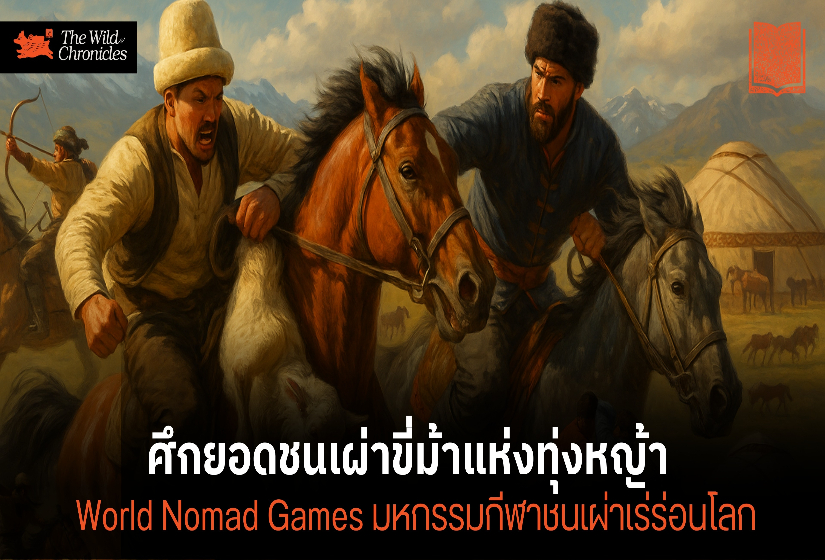
11. The last example is Er Enish, also known as horseback wrestling, a traditional sport that tests strength and the ability to control a horse in unstable situations.
In Er Enish, athletes ride horses and try to grab an opponent who is also on horseback. The goal is to pull, throw or swing the opponent off his horse.
What makes Er Enish different from ordinary wrestling is how hard it is to keep balance on a fast-moving horse. Athletes need a high level of riding skill together with muscular strength, agility and fighting instinct. Most of these athletes begin training in childhood to become familiar with movement on horseback, a skill handed down in the traditional nomadic way of life.
_________________________________________________
🐎 A cultural space
12. Besides being an international sporting stage, these games are also a "cultural space" where nomadic peoples from across Eurasia can proudly show their cultural identity.
Every time the event is held, the cultural dimension of the tribes is expressed through many elements, from dress and rituals to ways of living that truly reflect their roots.
13. One of the most striking is "tribal dress," as participants from each country or ethnic group wear traditional costumes handed down through generations. These are not just clothes but reflect each tribe's climate, way of life and social standing.
For example, the Kyrgyz wear the chapan robe and the felt kalpak hat, the Kazakhs wear gold-embroidered outfits in the style of nomadic warriors, and the Mongolians often wear the deel, a traditional robe commonly used when riding or traveling long distances.
14. The opening and closing ceremonies are another major highlight that has always impressed viewers. Each year a "story" is chosen that reflects the legends and beliefs of the nomadic tribes, such as the journey of a brave warrior, the legend of the god of the steppe, or the tribes uniting to overcome natural disaster, and used in the opening or closing ceremony.
The opening ceremony uses a large-scale show combining folk dance, light, color, sound and horseback riding into the scene, with more than a hundred performers in real tribal dress weaving these stories together into a magnificent open-air epic.
_________________________________________________
🐎 Problems to consider
15. Although the World Nomad Games have succeeded in reviving and spreading nomadic culture on the world stage, one of the most important challenges is "the sustainability of culture in a globalized world." They want to keep the "authenticity" of the nomadic way of life, trying not to let it change into just a show for tourism or a purely commercial folk festival.
16. Another problem to consider is the complex "international politics" among ethnic groups, peoples and powers such as Russia, China, Turkey and the Western bloc.
Using these games as a stage to link countries is a strength, but also a double-edged sword, because if political conflicts arise, such as border tensions or competition for influence in the region, they could also affect the organizing of the event, the choice of host, or the participation of some countries.
_________________________________________________
🐎 A modern sporting festival
17. While the culture and sports aim to keep their original character, the games also embrace modern technology and global trends. They have continually adapted to the digital world.
Competitions once watchable only at the venue have been developed so they can be broadcast live on online platforms such as YouTube, Facebook Live and even the host government's platforms, so viewers around the world can reach these sports more easily.
18. The most recent World Nomad Games were held in 2024, and the next are scheduled for 2026, not long from now...
In a world rushing toward modernity, the nomadic tribes still stand firm in their roots and pride in their traditional culture, and these games are the space where they tell that story in their own culture, through horses, bows, yurts and the spirit of the nomads of the vast steppe.
_________________________________________________
(Bonus) If you would like to watch these sports yourself without waiting until 2026, The Wild Chronicles has tours ready to take you within 2025 as well, whether a Kyrgyzstan tour where you can see kok-boru or the hunting with eagles practiced by the nomadic horse-riding tribes,
a Mongolia tour to the "Naadam Festival," which features many traditional sports centered on three events: horse racing, wrestling and archery,
or, if you want to experience nature and magnificent scenery, we have the "Pamir Highway" tour. This royal road linking the countries of Central Asia is regarded as "one of the most beautiful routes in the world" and has been dubbed the "road in the sky."
_________________________________________________
#TWCSummary #TWCKyrgyzstan #TWCMongolia #TWCTajikistan #TWCUzbekistan #TWC_Salmon