FILE Nº 0675 · History · DECLASSIFIED
“Xia Nanyang” (下南洋): The History of Chinese Migration to Southeast Asia
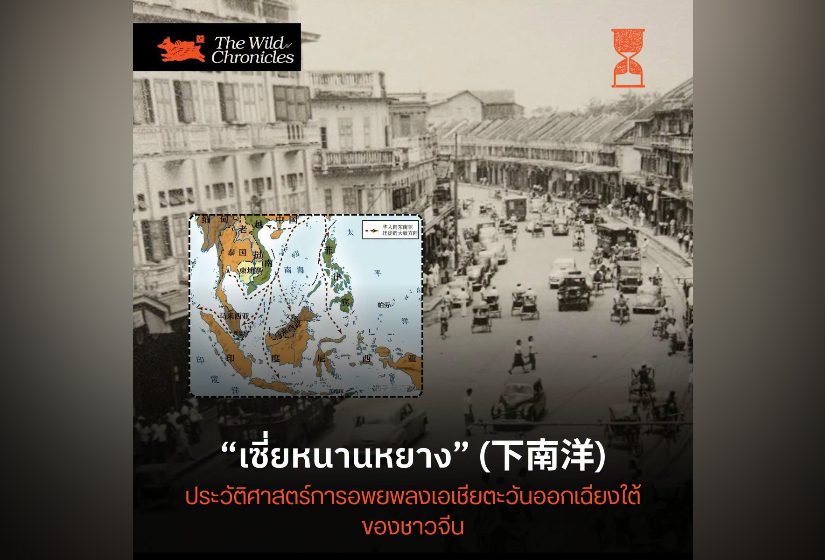
TL;DR — To my Thai-Chinese friends: have you ever wondered whether your grandparents' migration stories are part of one of history's biggest migrations?
To my Thai-Chinese friends: have you ever wondered whether the stories your grandparents told you about migrating to Thailand were actually part of one of the greatest mass migrations in world history?
If northern Chinese have a migration history called “Chuang Guandong” (闯关东), and those in the west have “Zou Xikou” (走西口),
then southern Chinese, whether Hokkien, Teochew, Hakka, Cantonese or Hainanese, have their own history of risking their lives to cross the ocean, called “Xia Nanyang” (下南洋), or in the local dialect “Guo Fan” (过番, crossing the border to a foreign land).
::: ::: ::: ::: ::: ::: ::: ::: ::: ::: ::: ::: ::: :::
Where is “Nanyang” (南洋)? And why “Xia” (下)?
In Chinese history, “Nanyang” means the southern seas, which is today’s Southeast Asia.
.
It covers Thailand, Malaysia, Singapore, Indonesia, the Philippines, Brunei and so on.
.
“Xia” means “down”, so together they mean “travelling down to the southern lands”. The Chinese journey to Nanyang did not happen in a single day but over thousands of years, and can be divided into the following major periods.
::: ::: ::: ::: ::: ::: ::: :::
1. The early period (Han to Ming dynasties)
Traces of the earliest migration date back to the Han dynasty. In the Tang and Song dynasties, Chinese merchants began to trade, bringing iron pots and cotton cloth aboard junks that followed the monsoon winds to trade and set up small communities around Java and the Malay Peninsula.
In the Ming dynasty, when Zheng He led his enormous fleet on voyages of exploration, some of the merchants and sailors settled down and married locals, creating a mixed Malay-Chinese culture known as Peranakan, or Baba-Nyonya, around the Strait of Malacca and Singapore.
In the middle to late Ming period, the imperial court enforced a policy banning people from going to sea. But driven by hunger, villagers took the risk, joining Teochew and Hokkien pirate groups such as Zhang Lian, Lin Daoqian (Lim To Khiam), and the pirate chief Chen Zuyi, who once commanded tens of thousands of men and hundreds of ships around the Strait of Malacca. These people became pioneers of the sea routes and founded the earliest Chinese communities in Southeast Asia.
In short, in the early period, most Chinese migrants were merchants, sailors or pirates.
::: ::: ::: ::: ::: ::: ::: :::
2. The dark era (late Qing dynasty, from 1860 onwards)
This is the period that mainly comes to mind when people say “Xia Nanyang”. In the late Qing, China faced wars both at home and abroad, a crisis of overpopulation, a shortage of farmland, and repeated natural disasters. At the same time, Western powers needed huge amounts of labour to develop their colonies in Southeast Asia.
After the Convention of Peking opened the way for foreign powers to recruit Chinese labour, a contract-labour trade emerged. Some people were deceived and lured away, while a vast number of poor villagers reluctantly left their homeland, heading abroad with a single hope: to earn money to send back to their starving families.
For the journey, Chinese travellers had to board red-headed junks (红头船) at the Zhanglin ancient port (樟林古港) in Shantou, or at Songkou port in Meizhou. The scene was Teochew and Hakka people carrying only a mat and a pillow, with lumps of dry biscuit to keep them alive, boarding red-headed junks packed tight in the hold.
With crowded, long voyages and no sanitation, the death rate on board was very high, giving rise to a sad saying among the Hokkien:
“十去六死三留一回头”
(Of ten who go, six die, three stay and settle, and only one returns home)
These red-headed junks sailed across the ocean and docked at ports all over Southeast Asia, and this was one of the periods when the most Chinese settled in Thailand.
They expanded out of large trading communities around Sampheng and Yaowarat, spreading to port towns and important commercial districts across Thailand, and became the ancestors of many Thai-Chinese families today.
::: ::: ::: ::: ::: ::: ::: :::
3. The era of fleeing war
After the Xinhai Revolution, the Republic of China government abolished the “piglet trade” (the coolie trade), but a second wave of mass migration erupted between 1926 and 1937 because of the warlords’ wars for power and the invasion by the Japanese army in the Greater East Asia War. Millions of Chinese had to flee south once again to save their lives.
Then came the founding of the People’s Republic of China by the Chinese Communist Party in 1949 and the start of the Cold War in the 1950s. China began to close its doors, with strict restrictions on leaving the country, which brought the Xia Nanyang migration to an end.
This closure was a major turning point for the overseas Chinese, because huge numbers of them could no longer return to their homeland. People who had once planned to earn money for a while and go home had to build houses and put down roots, adapt to local society and become permanent citizens, and they have helped build the nations of Southeast Asia to this day.
::: ::: ::: ::: ::: ::: ::: ::: ::: ::: ::: ::: ::: :::
4. The legacy of “Xia Nanyang” today
Today, more than 80% of the world’s overseas Chinese live in Southeast Asia. In Thailand, there are around 10 million people of Chinese or mixed Chinese descent, or 11–14% of the country’s population, and in Singapore, where the proportion of ethnic Chinese is highest, they make up 74% or more of the population.
From yesterday’s coolie porters, the descendants of the Xia Nanyang migrants have grown into business owners, national tycoons, thinkers, writers, and even political leaders at prime-minister and minister level in many ASEAN countries, along with the Chinese cultural heritage that has been passed down to us today.
And if anyone would like to follow in the footsteps of their Teochew ancestors with us…
P.S. Next year, The Wild Chronicles will be running a Shantou-Chaozhou tour in China, in March or April 2027!
This will be a relaxed tour with a chilled-out program and plenty of delicious local food, suitable for all ages, and especially for older travellers.
If you are interested, message our Line OA with the text “Interested in the Shantou tour” and you will receive the tour program in advance!
#TWCHistory #TWCChina TWC_Salmon