FILE Nº 0488 · History · DECLASSIFIED
The 7 Brave Soldiers of Gubeikou: Seven Against Hundreds, Fighting to the Death
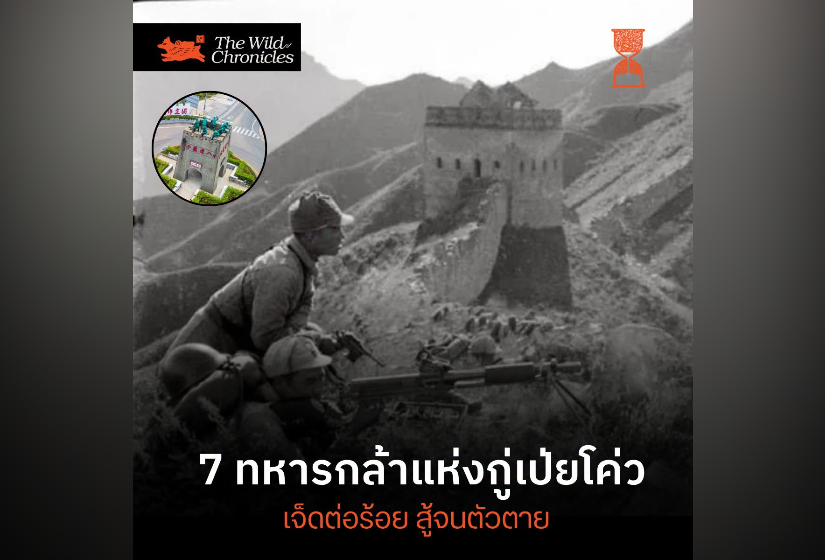
TL;DR — It started when I was wandering around Kinmen Island on Google Street View and came across an interesting roundabout called Badalouzi (八達樓子).
It started when I was wandering around Kinmen Island on Google Street View and came across an interesting roundabout. It is called Badalouzi (八達樓子), and in the middle stands a memorial built as a fortress tower, with 7 soldiers standing guard.
Of course, this tower has a story behind it…
In 1933, four years before the Marco Polo Bridge Incident, Japan had already begun its plan to build its own empire, invading China through Manchuria and the north.
The Japanese side, led by the 8th Division of the Kwantung Army, clashed with Chinese forces north of Beijing. The Kuomintang’s 25th Division was assigned to hold the Gubeikou Pass, which sits on the Great Wall of China.
However, the Japanese had far greater fighting capability than the Chinese. The Japanese army used both artillery and aircraft to carpet-bomb the Chinese defences, causing heavy damage.
On 12 March 1933, most of the Chinese forces had to withdraw from Gubeikou and fall back south to the Nantianmen defensive line.
But on a smaller strategic point called Mao’er Mountain (帽兒山), a towering peak in front of the Gubeikou Pass, a reconnaissance platoon of the 145th Regiment, 25th Division, had only a single rifle squad of 7 men stationed.
The telephone line connecting the 7 soldiers had been cut by artillery fire, so they never received the order to withdraw. When they saw the Japanese army moving through the valley below, they decided to use the high ground to fight to the very end, to buy time and cover the main force’s retreat.
They had only a few bolt-action rifles, 1 light machine gun and hand grenades, but using the boulders for cover they held off wave after wave of Japanese assaults. Over one full day they killed and delayed hundreds of Japanese troops, until the Chinese forces were able to retreat successfully.
When the Japanese could not storm the summit, they ordered 5 bombers to carpet-bomb Mao’er Mountain to pieces. Even with their ammunition gone and badly wounded, the surviving soldiers kept fighting with rocks and bayonets until all of them had died.
When the Japanese finally made it up Mao’er Mountain, they found that the force that had held up their advance that day was only 7 Chinese soldiers.
The Japanese commanders and soldiers were stunned by the courage and loyalty of the 7 men, so they gave them a dignified burial and set up a gravestone inscribed with the words “支那七勇士之墓” (Tomb of the Seven Brave Soldiers of China) as a mark of respect.
Later, in 1966, the 25th Division (nicknamed the “Changcheng Army”, or Great Wall Army) was stationed on Kinmen Island. To commemorate the heroic deeds of their fellow soldiers, they built a replica Great Wall fortress.
On top of the tower are statues of the 7 heroes in realistic combat poses. The square fort is decorated with the names of 4 important passes of the Great Wall: Gubeikou, Shanhaiguan, Xifengkou and Jiumenkou, along with 4 rousing slogans:
獨立作戰 (Fight alone)
自力更生 (Rely on yourself)
堅持到底 (Hold out to the end)
必勝必成 (Victory and success are certain)
#TWCHistory #TWCTaiwan #TWCChina TWC_Salmon