FILE Nº 0037 · History · DECLASSIFIED
The History of the Taiwan-China Conflict, Easily Understood in One Post
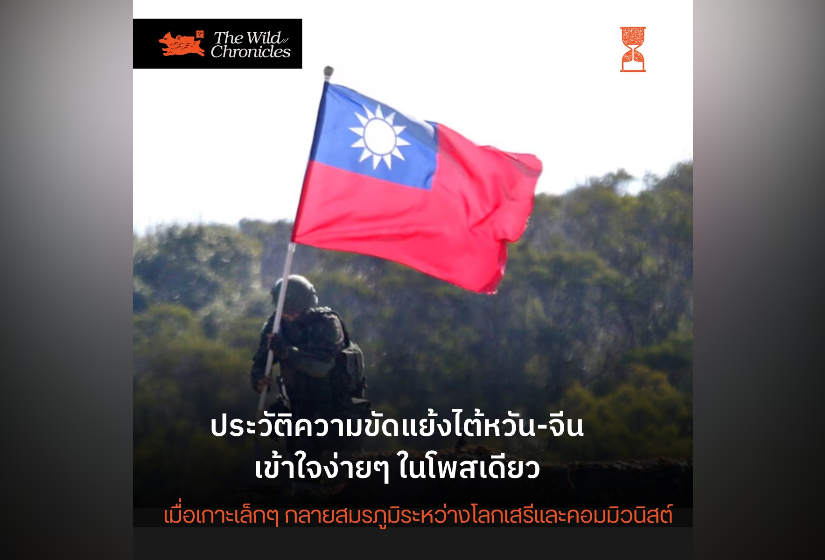
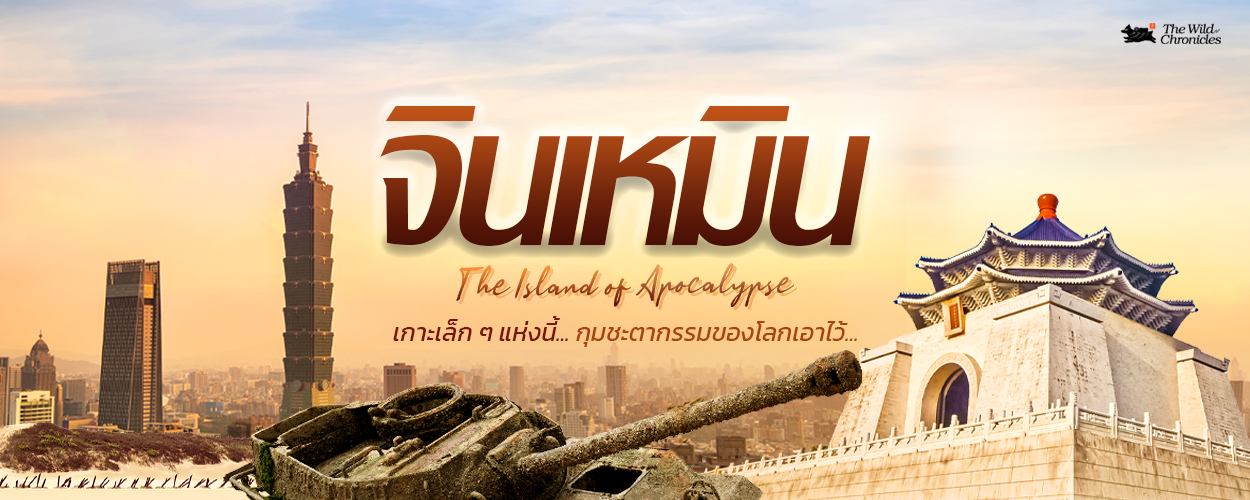
TL;DR — On 17 March, China sent warplanes and military drones to drill around Taiwan in response to Taiwan's president.
(((The History of the Taiwan-China Conflict, Easily Understood in One Post)))
On 17 March, China sent warplanes and military drones to drill around the island of Taiwan in response to Taiwan's president, after he continued to raise the issue of "separation" from mainland China and independence.
This still-simmering conflict is believed to be the likeliest front line if a third world war broke out between the free-world idea and the communist idea: a small island called "Taiwan".
Why is this island so important?
This story covers Taiwan's history of several thousand years, and how it came to be at the center of a global conflict.
It involves semiconductors, the 5th factor of the modern world.
It involves the dream of national unification and the interests of the world's great powers.
How will this story go?
Please follow along below.
_______________________________
◾Taiwan in the old days 🌌
◾The era of Japanese rule 🏮
◾The Kuomintang becomes the island's new ruler
◾The era of White Terror ⬜
◾Attacks from mainland China
◾The turning point and being cast adrift 🏝️
◾Taiwan as China's national interest
◾A key strategic point for the US 🦅
◾Taiwan's transition to democracy
◾Semiconductors as a shield against China 🖥️
◾Xi Jinping and the dream of unification 🎇
◾The return of President Trump
______________________________
🌓Taiwan in the old days 🌌
1. Originally the island of Taiwan was home to indigenous peoples for a very long time. Taiwan's indigenous peoples had their own distinctive cultures, languages and traditions, until the arrival of Han Chinese in the late Sui dynasty and early Tang dynasty, who began bringing their culture, language and technology to the island as well.
2. The next period was the arrival of foreigners. Dutch sailors sailed to the island and set up a stronghold in the south. The Dutch began changing how the indigenous people produced grain and hired Chinese laborers to work on rice and sugarcane plantations.
Spanish sailors who came later set up a stronghold in the north of the island before being driven out by the Dutch. The arrival of Western powers again brought economic, political and social change to Taiwan, until a Chinese warlord came and drove out the Dutch, establishing the Kingdom of Tungning on Taiwan.
3. The Qing dynasty sent an army to crush the Chinese warlord on charges of rebellion for creating the Kingdom of Tungning, which controlled Taiwan's western and northern coasts, before later declaring Taiwan a province of the Qing Empire.
🌓The era of Japanese rule 🏮
4. In 1895, after defeat in the First Sino-Japanese War, the Qing government signed the Treaty of Shimonoseki, which transferred sovereignty over Taiwan to Japan. Japanese rule lasted more than 50 years.
Japan governed the island strictly as a colony, bringing Japanese systems of bureaucracy, education and law into Taiwan, while also promoting the use of Japanese and having Japanese people move in and settle in Taiwan.
5. However, Japan was also an important factor in developing the island. They invested in developing Taiwan's infrastructure, education and economy, such as roads, railways, ports and power plants, promoted agriculture, and developed industry on the island.
Japan modernized Taiwan's infrastructure and economy, and Taiwanese people received more education, until Japan's defeat in the Second World War finally returned the island to Chinese hands.
🌓The Kuomintang becomes the island's new ruler
6. The Kuomintang was the governing party of mainland China since the fall of the Chinese dynastic system and the founding of the new Republic of China. But while the Kuomintang was dominant and fighting a civil war with the Chinese Communist Party, the Second Sino-Japanese War broke out, and the Kuomintang's resources and manpower were spent on this war.
So when the war ended, although it had won over Japan, its main forces had suffered heavy losses from the war. Moreover, the tactics the Kuomintang used enraged the people greatly, when it ordered dams to be destroyed to cause floods to slow the Japanese advance, which also killed more than 800,000 Chinese people. In the end, Chinese support shifted toward the Chinese Communist Party.
7. The Chinese Communist Party under Mao Zedong and the Kuomintang under Chiang Kai-shek began a political war again after the peace talks failed in 1945. Although Chiang Kai-shek had the upper hand at first, the tide of war began to turn in 1947 as corruption eroded the army, the US reduced its support for the Kuomintang, and battle planning errors let the Chinese Communist Party take more and more territory.
By early 1949 Chiang Kai-shek knew he could no longer resist, and finally withdrew his government, along with more than a million people, to the island of Taiwan by the end of that year, while Mao Zedong successfully proclaimed the founding of the People's Republic of China (PRC), marking the end of the long civil war.
🌓The era of White Terror ⬜
8. The Kuomintang, setting up a government in exile on Taiwan, was not much liked by the islanders. When the Kuomintang was still the government on the mainland, it had declared martial law on the island to suppress protests, and when the Kuomintang came over it extended martial law, citing the need to prevent a possible invasion by the Chinese Communist Party, for more than 38 years.
This long period of martial law is called the "White Terror" era, a dark time in Taiwan's history full of political repression, human rights abuses and severe restrictions on freedom.
9. Under this martial law, the government had the power to arrest, imprison and execute those accused of being communists or political dissidents with no limits. Even language was affected: Taiwanese students were forced to use Mandarin at school, and the Taiwanese Hokkien language was strictly forbidden.
10. The 228 Incident: government officers seized smuggled cigarettes from a woman vendor in Taipei, and when she resisted they shot her on the spot. When the public learned of it they marched in protest, angry at the government, but what they received was a hail of bullets fired coldbloodedly at defenseless people. The incident killed thousands.
🌓Attacks from mainland China
11. The Chinese Communist Party, having set up a government on the mainland, made several attempts to attack and advance on Taiwan, including attacks on Penghu, the Kinmen islands and Matsu, but the US intervened to block it every time.
On the international stage, the Republic of China, or Taiwan, was still recognized as the representative of China, because Western nations and the US worried that if Taiwan were allowed to fall, the influence of communism might spread across all of Asia. It would not be wrong to say the United States was a key factor in keeping Taiwan from being attacked while it was weak.
🌓The turning point and being cast adrift
12. The turning point came when the US under President Richard Nixon saw the benefit of the conflict between China and the Soviet Union. He saw that China had a huge population, resources and economic interests, and could be used to counterbalance the Soviet Union. Diplomatic relations between China and the US thus began.
13. Under the One China policy, meaning that mainland China is the legitimate government and not the one in Taiwan, countries that wanted to trade with China had to recognize this policy and cut relations with Taiwan. The trend among nations, including the US, leaned toward China, and a United Nations resolution finally made Communist China the legitimate China and seated it in place of Taiwan in the permanent seat on the Security Council.
This was followed by the US finally recognizing the People's Republic of China, or Communist China, as the legitimate government and cutting diplomatic ties with Taiwan.
14. Although China had beaten Taiwan on the international stage, China at that time was still in its infancy and developing its economy, not in the flourishing state of the present-day image. Doing anything rash, such as invading Taiwan, was seen by China's leaders then as certainly not worth the cost. Peaceful unification was therefore the path China chose, and it continues to the present.
🌓Taiwan as China's national interest
15. Besides political reasons, the island of Taiwan is strategically important to China in the South China Sea. The Nine-Dash Line is the line China uses to claim most of the South China Sea. China wants to hold this sea for several reasons. First, it is one of the busiest shipping lanes in the world. Controlling Taiwan would help China control navigation in this region and reduce the influence of Western nations and US allies who use this route to transport goods and resources.
Next, if China wants to expand its naval power in the South China Sea, where it has disputes with several ASEAN countries, controlling Taiwan would help China extend its military influence into the western Pacific and the South China Sea more easily. Taiwan also serves as China's first line of defense; if China cannot control Taiwan, the US and its allies might use Taiwan as a base close to the Chinese mainland.
Finally, the South China Sea is rich in natural resources, both fisheries and energy resources such as oil and natural gas. If China could control Taiwan, it would be easier to reach and protect the resources in the South China Sea.
🌓A key strategic point for the US 🦅
16. The US regards Taiwan as a strategic point that must be protected. The US and its allies use a defensive line called the "First Island Chain", a chain of islands stretching from Japan, Taiwan and the Philippines to Indonesia, to contain China's influence, especially the People's Liberation Army Navy, so that it cannot freely expand its maritime power into the western Pacific.
So Taiwan's existence is extremely important, because it makes it possible to control the Taiwan Strait, an important shipping lane. If China could control Taiwan, this defensive line would collapse, and China could extend its maritime influence into the Pacific much further.
17. Countries in the region fear that China's influence would spread. If Taiwan were allowed to fall, China would gain access to key strategic points and resources, and the next target in a later war might be their own countries. So if a China-Taiwan war really broke out, Japan and regional allies such as Australia might join in responding to defend the island.
The US itself also has the Taiwan Relations Act, which pledges to help defend Taiwan if attacked by China. These factors might lead to a large-scale war that even China does not want, so China's path of peaceful unification continues.
🌓Taiwan's transition to democracy
18. As democracy blossomed among the people of Taiwan, Kuomintang leaders believed that if they kept opposing the will of the people, the party's power would soon be overthrown. Adapting to an electoral system would preserve their power base, which is why martial law was lifted in 1987.
19. During that period of elections, two parties rose to compete fiercely in Taiwan: the Kuomintang, which supported the "unify with China" line, and the Democratic Progressive Party (DPP), which stressed that "Taiwan is independent of China".
The DPP's victory over the Kuomintang in 2000 underlined the will of the Taiwanese people that they chose to be 'Taiwan', no longer 'China', since the DPP's idea is to make Taiwan independent and no longer one China.
🌓Taiwan's semiconductors: the heart of world technology and a shield against China
20. China has responded to Taiwan's idea of independence with ever harsher measures, diplomatic, military, economic and political. We may often see images of China conducting drills around the island of Taiwan when events suggest that Taiwan wants to separate from China.
21. But if you look closely, China has never attacked the island of Taiwan directly. A key part of the reason is Taiwan's semiconductor industry, the computer chips, which matter enormously to China itself and to the whole world.
More than 65% of the world's computer chips, and 90% of the world's most advanced chips, are made by TSMC (Taiwan Semiconductor Manufacturing Company), the world's largest chipmaker. These chips are used in smartphones, computers, cars, artificial intelligence, and modern weapons.
If China really launched an attack on Taiwan, the chip factories might be destroyed and the world would enter a technology shortage crisis. This concern means the US and its Western allies cannot let China destroy or control this industry, because that would let China dominate the world in technology, so the great powers must step in to protect Taiwan from China's threat.
🌓Xi Jinping and the dream of unification
22. Xi Jinping once served as provincial Communist Party leader in Fujian, directly across from Taiwan. He actively promoted economic cooperation with Taiwan, persuading Taiwanese investment into projects linking trade and shipping between Fujian and nearby Taiwanese islands.
This work influenced Xi's later policies.
In Xi Jinping's view, the conflict between mainland China and Taiwan is a result of China's "weakness" in the past. He therefore believes that unifying China is a historic mission China must accomplish to restore the nation's greatness.
23. For example, in the recent New Year, China's President Xi Jinping said in a speech, in essence, that unification of the two sides 'cannot be stopped by anyone'. Chinese people on both sides of the strait are one family, no one can sever the blood ties, and no one can stop the historical tide of reunification.
🌓The return of President Trump
24. Trump's rise to the presidency has upended relations between the US and its allies, especially his economic policy of being ready to impose reciprocal tariffs on countries with a trade surplus with the US, of which Taiwan is one.
Trump showed clear displeasure with Taiwan during a podcast appearance, claiming that Taiwan stole America's chip industry, and even threatened to tax imported chips.
25. But his stance on policy to prevent China from using force to take control of Taiwan remains ambiguous. Trump declined to comment on China taking Taiwan by force.
26. Although the Taiwanese government still maintains its independence and democracy, the political game between Taiwan and China continues. The key factors now are none other than the US and the semiconductor industry, which have become the determinants of the island's fate.
How long can Taiwan keep this fuse from burning? Will war happen in our lifetime? Or could peaceful unification really happen? What do you think? ……….
#TWCSummary #TWCTaiwan #TWCChina #TWC_Salmon
References :
taiwan(ดอต)gov(ดอต)tw/content_3(ดอต)php
disasterhistory(ดอต)org/yellow-river-flood-1938-47
britannica(ดอต)com/event/Chinese-Civil-War
britannica(ดอต)com/event/White-Terror-Taiwan
taiwaninsight(ดอต)org/2022/12/20/kuomintang-through-the-ages/
aljazeera(ดอต)com/news/2021/10/25/chinas-un-seat-50-years-on
adst(ดอต)org/2016/08/chinas-fight-for-tiny-islands-quemoy-matsu-taiwan-straits-crises-1954-58/
usip(ดอต)org/publications/2024/01/silicon-shield-looking-beyond-semiconductors
congress(ดอต)gov/bill/96th-congress/house-bill/2479
thedefensepost(ดอต)com/2025/01/01/chinas-xi-unification-taiwan/
infoquest(ดอต)co(ดอต)th/2025/473466
Image reference :
gdb(ดอต)voanews(ดอต)com/8d934230-0246-4c1f-ab11-0d826451d2c1_w1023_r1_s.jpg