FILE Nº 0078 · Travel · DECLASSIFIED
Holi, India's Festival of Colors, Is Not the Origin of Thailand's Songkran
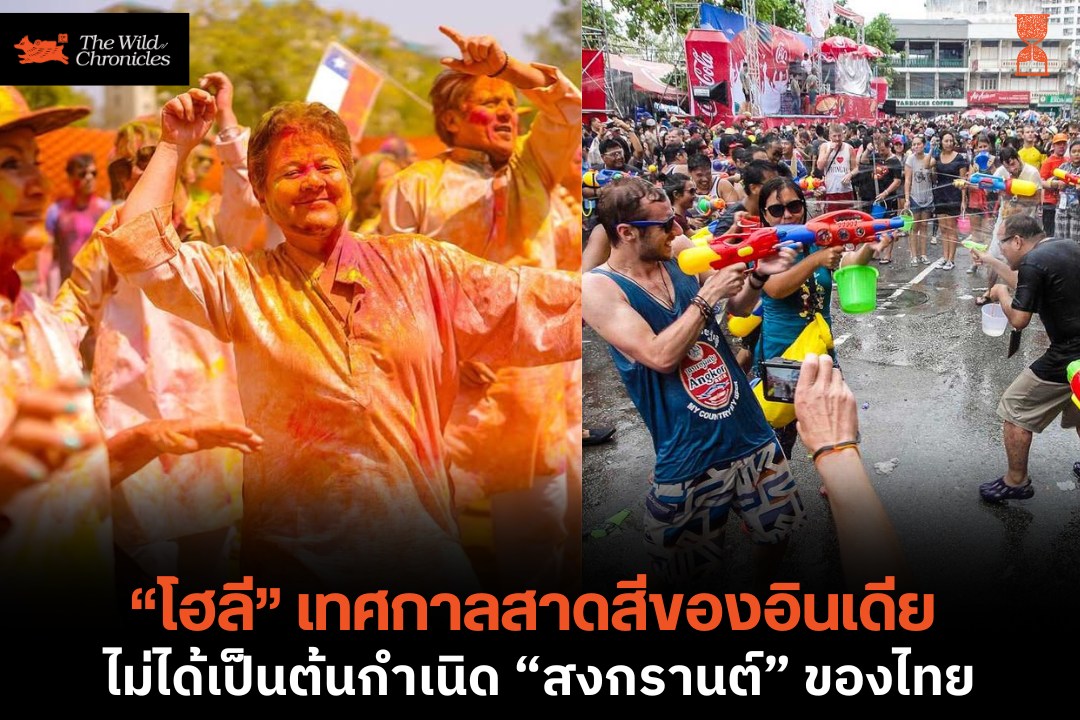
TL;DR — Many people think India's famous festival of colors, Holi, may be linked to Thailand's water festival, Songkran, but the two may be unrelated.
"Holi", India's famous festival of colors, is a festival many people think may be related to Thailand's water-splashing festival, or "Songkran" tradition, because Thai Songkran also has its roots in India. Many believe this is true, but in fact the two festivals may not be related at all.
The reasons many scholars think Holi is not the model for Thai Songkran are:
1. Timing
The two festivals are based on different calendars. Holi follows the Hindu lunar calendar, held on the full moon, the 15th day of the month of Phalguna (the 3rd month), around February to early March. This day is called "Holika Dahana", meaning the day of burning Holika. The next day, the 1st day of the waning moon in the month of Chaitra (the 4th month), is called "Holi" or "Vasantotsava", meaning the festival of spring, and is the day of throwing colors and various recreational activities (in 2025 it fell on 14 March). This differs from Songkran in Thailand, which uses the South Indian solar calendar and usually falls on the same dates every year.
2. Meaning
Thai "Songkran" is the "new year", or the change of era according to astrology, following South India (Tamil). Songkran refers to the sun moving from one zodiac sign to another (normally the sun changes sign once a month, so there is a Songkran every month), but its entry into Aries is the hottest and most energetic time, so the Tamils and the Thais made Songkran the new year.
Holi, meanwhile, has nothing to do with a change of era. It celebrates the end of winter and welcomes spring, the season when planting begins, and conveys the victory of good over all evil through the ritual burning of Holika. The play of throwing colors also expresses love for Krishna and Radha.
3. Main activities
Originally, Holi in India did not involve splashing water. Villagers gathered up rubbish and made a figure of "Holika" (a symbol of drought), then lit it and played around the bonfire. The color-throwing was added later and is celebrated mainly in northern India. Thai Songkran, meanwhile, originally centered on pouring water over the hands of elders, and splashing water was not the main activity but came later. So it is unlikely that water-splashing was influenced by Holi.
From these 3 reasons, we can conclude that "Holi", India's festival of colors, is not the origin of Songkran in our country. Nevertheless, both are festivals of fun that people inside and outside their countries eagerly await and join in with enthusiasm.
References
Silpa-mag (ดอท) com/culture/article_129892
Matichon (ดอท) co (ดอท) th/prachachuen/news_74221
Matichon (ดอท) co (ดอท) th/prachachuen/news_2139582
Matichon (ดอท) co (ดอท) th/prachachuen/news_2139582
Khaosod (ดอท) co (ดอท) th/special-stories/news_964291
#twchistory #twcindia #twcthailand