FILE Nº 0052 · History · DECLASSIFIED
Kashmir: A Land Disputed by Three Nations, India, Pakistan and China
TL;DR — In 1947 Britain, exhausted by the world war, no longer had the authority to rule the British Raj and agreed to grant independence.
In 1947 Britain, exhausted by the world war, no longer had the authority to rule the British Raj and agreed to grant independence. But Hindus and Muslims hated each other so much that they could not live together (partly a result of Britain's divide-and-rule policy), so the British Raj was split into two countries: India, the country of the Hindus, and Pakistan, the country of the Muslims.
At that time many parts of the British Raj had their own rulers (mostly called maharajas), and Britain gave these rulers three choices: 1. become independent, 2. join India, 3. join Pakistan.
Most maharajas chose a country according to their religion. But the problem was that Hari Singh, Maharaja of Kashmir (spelled "Kashmir" here, "Kaśmīr" in the local form), was Hindu while most of his people were Muslim. Kashmir's population was 77% Muslim and 20% Hindu, with the rest Buddhist in Ladakh and Sikhs scattered here and there. The maharaja did not want to force any part of his people, so he intended to remain independent.
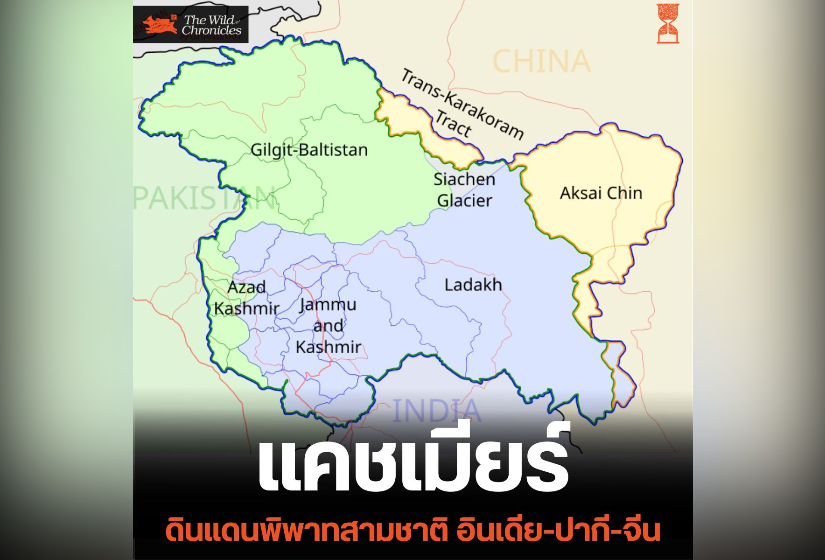
But Pakistan wanted to possess Kashmir for strategic reasons and tried to intervene with military force. This led Hari Singh to accede to India in order to ask for Indian forces to defend the state, and it became the India-Pakistan War of 1947-1948. The result was a ceasefire in which India held two-thirds of Kashmir and Pakistan one-third.
India received the parts called Jammu and Kashmir, and Ladakh; Pakistan received Azad Kashmir, Baltistan and Gilgit. But China took advantage of the turmoil between Pakistan and India, attacked India and seized Aksai Chin. So today the Kashmir region is governed by three countries: India, Pakistan and China.
The major population groups in the whole Kashmir region include the Kashmiris, who speak Kashmiri; the Punjabis, who speak Punjabi; and the Pashtuns, who speak Pashto. These groups are mostly Muslim or Sikh. There are also the Ladakhis, who are mostly Buddhist and close to the Tibetans.
P.S. I once had a chance to talk with a Hindu nationalist from India. He was very annoyed that we say "Kashmir"; it must be "Kaśmīr" in the local form only. Pakistanis are happy because the name "Kashmir" sounds more mainstream. As for China, it is planning to build a railway linking Aksai Chin and Xinjiang.
#TWCHistory #TWCIndia #TWCPakistan #TWCChina #TWC_Rama