FILE Nº 0596 · History · DECLASSIFIED
"Operation Searchlight": The Tragedy That Killed Millions of Bangladeshis
TL;DR — Bangladesh is known today as one of the most densely populated countries in the world, with a fascinating language and culture of its own.
((( "Operation Searchlight": The Tragedy That Killed Millions of Bangladeshis )))
"Bangladesh" is known to many of you today as one of the most densely populated countries in the world, with a fascinating language and culture of its own.
But go back before 1971 and this was "East Pakistan," part of the country of Pakistan, which had been joined to "West Pakistan" after the partition of India and Pakistan.
That union did not come from the free will of the Bengalis. It was the political result of the great powers and political leaders of the time, and it produced a strange "country of Pakistan," since its two parts were separated by more than 1,600 kilometers of India, even though the Bengalis in the east spoke Bengali and had a culture, art and historical roots different from those of the rulers in West Pakistan.
In the end, differences of language and culture became the tinder of conflict. The central Pakistani government declared Urdu the sole official language, igniting the "Language Movement" of 1952, in which many Bengalis gave their lives to defend the honor and the right to use their mother tongue.
Economic inequality was also stark. Most of the country's income and budget was concentrated in West Pakistan, while East Pakistan, which had the larger population, was neglected in investment and development. Although this land produced the main income for Pakistan, most of the benefits flowed to the west.
All this made the Bengalis feel like "second-class citizens." Bengali nationalism gradually grew stronger and led to a great breaking point, when the Pakistani army launched an operation called "Operation Searchlight" to crush the Bengalis' dream of independence...
What was the aim of this operation, and how great was the brutality inflicted on the people of Bangladesh?
Follow along with me...
_________________________________
🛞 West Pakistan
🌡️ Boiling point
🪖 Operation Searchlight
⚔️ The resistance
💬 The Third Indo-Pakistani War
_________________________________
🛞 West Pakistan
1. After Pakistan was founded in 1947, the country was split into two parts very far apart: West Pakistan (today's Pakistan) and East Pakistan (today's Bangladesh). The two regions differed greatly in language, ethnicity and culture.
Westerners spoke Urdu, while the easterners were mostly Bengalis. Although the population in the east was larger than in the west, government and the allocation of the budget were monopolized by the elite from the west.
2. The differences became clear with the "Language Movement" in East Pakistan in 1952.
When the Pakistani government declared Urdu the sole official language of the whole country, the Bengalis, more than 50 million Bengali speakers at the time, protested widely.
On 21 February 1952, police and soldiers opened fire on student protesters at the University of Dhaka, killing several. This event became a major turning point, igniting the feeling that the Bengalis were being oppressed in both language and identity.
3. By 1966, Sheikh Mujibur Rahman, leader of the Awami League, put forward the "Six-Point Programme." Its core was to lay the foundation for self-rule in East Pakistan. The points included the right to control economic policy, taxation, the use of revenue and local financial control, reflecting discontent that the resources of East Bengal were being absorbed mainly to develop the west.
4. The point that accelerated the worsening of the situation came in the 1970 general election, when the Awami League won a landslide in East Pakistan, taking 167 of the 169 seats, enough to form a national government. But the West Pakistani side would not accept the result, while General Yahya Khan, the president and commander-in-chief, postponed the opening of the assembly to stall for time. This decision enraged the Bengalis throughout the east and led to massive protests under the leadership of Mujibur Rahman.
_________________________________
🌡️ Boiling point
5. With the other side still refusing to accept the election result, in March of the following year Rahman's camp announced a "non-cooperation movement," calling on Bengalis to stop paying taxes, not to obey central government orders, and to run their own affairs. Dhaka and the major towns filled with millions of protesters gathering and shouting "Joy Bangla" (Victory to Bengal). The atmosphere of independence began to be clear.
6. The Pakistani government responded by continually sending troops from the west to reinforce East Pakistan. At the same time, clashes broke out between Bengalis and the Biharis living in Chittagong and other areas, leaving several hundred dead. These events reinforced the Pakistani army's belief that it had to "deal with it decisively" to prevent secession.
In the end, when political negotiations between Yahya Khan and Mujibur Rahman failed, "Operation Searchlight" was planned in March 1971. The plan had a clear aim: to crush the political strength and resistance of the Bengalis in a short time. Military leaders stationed in East Pakistan who objected were ignored and removed from their posts.
7. The conditions for the plan's success were:
1. The operation had to begin simultaneously across all of East Pakistan.
2. As many political leaders, student leaders, and important figures in cultural organizations and among the faculty as possible had to be arrested.
3. The operation in Dhaka had to succeed 100%, with the University of Dhaka seized and thoroughly searched.
4. The use of armed force and gunfire was permitted without restriction, for the safety of the army camps.
5. All domestic and international communications had to be cut, including telephone, television, radio and telegraph.
6. East Pakistani troops (soldiers of Bengali descent) had to be disarmed and rendered unable to fight.
7. To deceive the Awami League, President Yahya Khan was to pretend to keep negotiating and to appear to accept the Awami League's demands.
The operation began on the night of 25 March 1971 and became the prelude to one of the most violent massacres in South Asian history.
_________________________________
🪖 Operation Searchlight
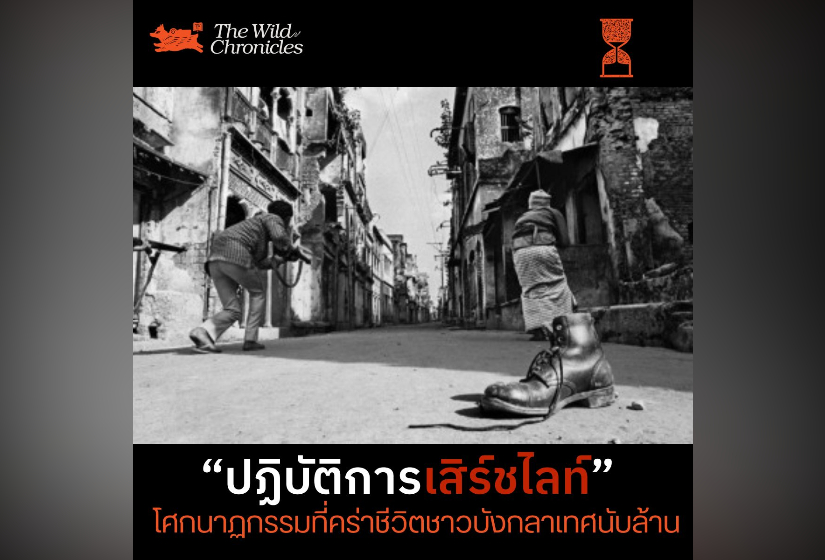
7. The night of 25 March 1971 was the start of Operation Searchlight, when the Pakistani army launched its attack on Dhaka, the capital of East Pakistan. A curfew was declared at 1:10 a.m., and telephone, telegraph and radio stations were shut down along with all transmitters. The city was sealed off, with troops taking full control of the roads, railways, waterways and river patrols.
Infantry forces with tanks and heavy machine guns moved into the districts of Dhaka, from Old Dhaka to the University of Dhaka, the center of the intellectuals and students who played a leading role in the movement for independence.
8. The student dormitories in Dhaka were shelled indiscriminately, because the students were among those who wanted independence. Many students and teachers were killed on the spot. Some of those arrested were forced to line up and were shot in front of their friends. The death toll at the University of Dhaka that night ranges from several hundred to over a thousand.
9. Beyond the university, the army also attacked key places such as the airport, the television station, newspaper buildings, and the residential areas of Awami League activists.
Those seen as leaders of the separatist movement were hunted down and killed. Meanwhile, Sheikh Mujibur Rahman was arrested at his residence and immediately sent to be imprisoned in West Pakistan.
By the morning of 26 March, Dhaka had become a city full of ruins and countless corpses. Many witnesses described it as "the longest and most horrifying night in Bengali history."
10. Dr. Mokerrom Hossain, a professor in the Department of Sociology and Criminal Justice at Virginia State University, described the events of the night of 25 March:
"When the attack began, army tanks moved off in different directions to destroy their targets. One force advanced along the main road from the airport into the city and attacked the newspaper offices in front of the Radio Pakistan Dhaka office, and the same force took control of the radio station. Another force headed to the University of Dhaka and attacked the student dormitories."
This attack was recorded on video by a professor from the East Pakistan University of Engineering and Technology (later Bangladesh). The tape of the event was smuggled out of the country to report the massacre directly to the outside world. In the area of the student dormitory attack, there were also targeted attacks on the faculty housing, and a few professors were killed on that terrifying night.
11. In Old Dhaka, 700 people were also burned to death by fire while still alive, and information collected from many sources at home and abroad indicates that in that brutal night as many as 7,000 Bengalis died in Dhaka alone."
(Many records say tens of thousands of people were killed in these two months.)
12. After taking Dhaka, the Pakistani army extended the operation to the port city of Chittagong on 27 March. Many residents united to resist, seizing an arsenal and clashing with the Pakistani army, but in the end the city was brutally suppressed. Shelling of entire villages and mass executions continued.
13. The number of deaths over the whole course of the operation is still disputed. Some sources estimate at least several hundred thousand, while the Bangladesh government estimates as many as 3 million deaths throughout the Bangladesh Liberation War, including those killed directly in the crackdown and those who died from humanitarian effects such as famine, epidemics and enormous numbers of refugees.
(Wikipedia states that about 10 million people fled East Pakistan and about 6.7 million had to stay in more than 825 refugee camps.)
14. The West Pakistani army quickly took control of key areas of East Pakistan between April and May 1971. The Pakistani army was able to pressure local forces and set up an administration under its own control. Although resistance was scattered everywhere, strategically the Pakistani army held the main cities and key transport routes throughout the east within less than two months of the start of the operation.
However, this occupation was only a "temporary victory," because although the army controlled the cities and roads, the countryside and border areas were full of forces that gradually began resisting through continuous guerrilla warfare.
_________________________________
⚔️ The resistance
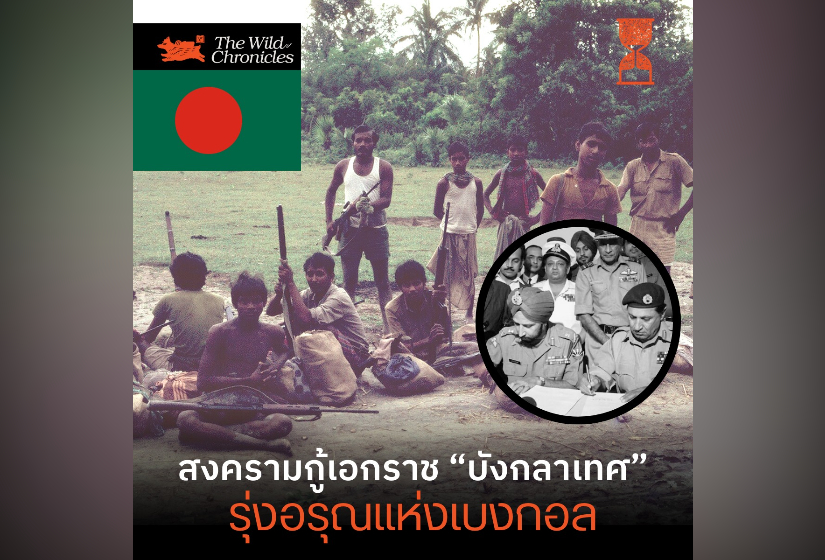
15. The crackdown did not make the people of Bangladesh surrender entirely. On the contrary, it angered villagers, students, former soldiers and many police, who turned to join the resistance force called the Mukti Bahini, or Bangladesh Liberation Army, which had only just been formed during this war.
16. They used guerrilla tactics, ambushing the supply lines and bases of Pakistani troops in the countryside and along transport routes. These forces were supported with shelter and supplies by villagers, and received training and weapons from neighboring India across the border.
The fighting between the two sides was extremely fierce. West Pakistan used every method it had to suppress the Mukti Bahini, committing the army, navy and air force. Even so, they were hard to defeat, because they were not a force that stood its ground and fought set battles.
17. However, these tactics left many villagers as victims of violence, and led an enormous number of people from East Pakistan to flee the country. Nearly 10 million refugees crossed the border into the Indian states of West Bengal, Assam and Tripura. This continually escalating violence opened the way for India, Pakistan's fiercest rival, to play a role in intervening directly in the war.
_________________________________
💬 The Third Indo-Pakistani War
18. The flood of nearly 10 million Bengali refugees from East Pakistan into Indian territory became one of the greatest humanitarian crises in contemporary history. The burden of caring for this enormous number of refugees inevitably affected India's economy and society directly, and also pressed the government of Indira Gandhi to seek a response, since India and West Pakistan already had political and security conflicts.
19. At first India did not want to come into direct conflict with West Pakistan, so it chose to support the independence struggle of the Mukti Bahini by providing military training and sending weapons and equipment, while avoiding direct clashes with the Pakistani army.
20. India's continued support for the Mukti Bahini, in training, supplying weapons and giving refuge to people from East Pakistan, put heavy pressure on West Pakistan. Relations between the two countries, already tense, became even more fragile. The Pakistani government saw that if things were left to continue, India might escalate its support until it intervened directly.
To keep India from gaining the upper hand, West Pakistan decided to play an offensive game, launching 'Operation Chengiz Khan' in late 1971 with attacks on several Indian air bases on the western side, hoping to destroy India's air capability and gain a strategic advantage. Instead it set off the full-scale outbreak of the "Third Indo-Pakistani War" in December of the same year.
21. This war sent the Indian army into East Pakistan, coordinating with the Mukti Bahini in the countryside and border areas. The ultimate goal on the eastern front was to take Dhaka, while the western front aimed at stopping Pakistan from extending its attacks into India. The conflict thus erupted into a full-scale major war, which in the end led to a historic change and the birth of a new state, "Bangladesh."
#TWCHistory #TWCbangladesh #TWCIndia #TWCpakistan #TWC_Salmon